June 4th, 2009
Behavior First, Design Second
Not a day goes by without someone I follow on Twitter complaining that others are too focused on growing their follower numbers. Just yesterday someone who I know to be a very calm person went on a verbal rampage complaining about someone who was way too worried about getting more followers…by doing things like saying “Please retweet!” or “Follow me!” one too many times.
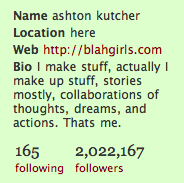
But really, who doesn’t at least notice how many followers they have? And, if you were honest, wouldn’t you say that if you had to choose, you would probably want more rather than less followers?
Here’s a question: how would Twitter change for you if you didn’t know how many followers you have? What if the designers at Twitter removed the number from all screens/APIs and forced you to rely on replies or retweets to let you know what was going on? Would that be OK with you? How would it change your behavior?
Humans are hard-wired for attention. My newborn girl, for example, cries when she’s not getting attention. My 3 year old, who isn’t used to not having attention, is going through a major psychological shift in her life because she’s realizing that she isn’t the only child in the universe…she now has a sister who will be getting attention as well. Attention is a core human issue for all of us. As designers we need to keep this in mind.
I use follower numbers in several ways to judge the type of person who is on the other end. If I’m followed by someone who has very low following/follower numbers, then I know they’re probably new to Twitter. If someone has really high following/follower numbers, then I know they’re probably an auto-follower, which suggests they might not focus on quality conversation as much as attention. If someone has high follower numbers and low following numbers, then I know they have an audience for some reason (it might not be a good reason). Obviously, these numbers don’t tell you everything…but I use them to give me an idea. When metadata is available…humans will look at it.
We don’t just collect attention, of course. We collect lots of things. Most video games are built entirely around the premise of collecting things. The more you collect the higher your score. The more coins that Mario and Luigi collect, the better they do. It’s a causal relationship. We understand when playing these games that collection is the way to achieve success. For more on the psychology behind gaming and collecting, read The Psychology Behind Item Collecting And Achievement Hoarding.
Of course, games did not instill the collecting behavior in humans. Gaming merely exploits it. We haven’t become collectors because of technology. We use technology to help us collect things. We’ve been collecting objects forever…art, seashells, books, firewood, paper clips. A core human behavior is collecting things, real and virtual.
As designers we must remember that behavior comes first. Always. The quirky, the obscure, the vain, the annoying, the wonderful. We need to observe human behavior if we are to support it in design. If people collect things, how can we support that? If people are vain…how does that affect the design? Will it kill some interesting behavior…or will it help drive adoption of the service?
You’ll find that many successful social software products/services focus on the collection of social objects such as photos, bookmarks, friends, vampires. This is no accident…people collect things as a natural matter of course. Software that supports the behavior will naturally be more successful.
We also have the opposite case…when we have nothing. This is particularly relevant when talking about people new to a service…when you just join a social network, for example. So the scenario is this: you sign up, you land on a dashboard of some sort, and you have nothing. No friends, no posts, no pictures, no bookmarks, nothing of any kind. It’s not a good feeling…and its a great way to drive people away.
It’s like we’re saying: “Hey you, the one with the collecting behavior…yeah you’ve got nothing!…you better start collecting!”
So as designers we can actually satisfy the collecting behavior at the same time we’re helping people get started with software. Do what MySpace did and give everyone at least one friend to start with (when you join MySpace you are automatically friends with Tom) Or, you can provide a sample post to let people know what a post is and how it works. Or, if you’re building an activity stream why not seed it with a few items so that people know what that’s like? It’s kind of like giving people a place to sit when they move into a brand new home.
So, back to behavior. Some behaviors that drive us nuts are core to the human experience:
- We want attention.
- We collect things.
- We want status.
- We are vain.
- We make judgments accordingly.
These behaviors aren’t going away anytime soon. So instead of decrying such behavior, we need to embrace it! We need to figure out how it fits within the context of what we’re building. Sometimes it won’t. But we can’t dismiss it. If we are really serious about designing great software then we have to at least give this type of behavior some thought, considering whether we should or whether we can damp it or amplify it.
And, from time to time, possibly even take advantage of it.

Links to this Post
Comments
1. ben_ 9:37am, Thu 4th, 2009
Great Article. Makes me once again happy, that I left Twitter a few months ago. Thanks!
2. WebDevHobo 10:10am, Thu 4th, 2009
how would Twitter change for you if you didn’t know how many followers you have?
In my case, it probably wouldn’t matter. I simply follow people who are clearly webdesigners/developpers, have a blog on which they post and such things. It’s usefull catching all their blogs and then saving them on Delicious.
3. Chris 10:19am, Thu 4th, 2009
Excellent post Josh, especially the part on people coming to social networks for the first time with nothing. It’s a very empty experience when that happens and something I noticed on my own social network, people would join but didn’t interact with the service. Why? Because they didn’t have anyone to interact with. Twitter had the same problem which is one of the reasons I think the they introduced the recommended followers option post signup.
4. kingjohnny 10:20am, Thu 4th, 2009
nice article and I couldn’t agree more. I believe that it is not the number of followers that matters so much, but the number of conversations. More and more I feel like twitter (for me) is not a two way communication medium, but a one way. Because of the things I tweet (in hope for a respons) will be ignored or just not read. For me twitter is a way to start a conversation, not collecting followers. I’d rather have a few followers with a lot of conversations, than loads of followers who ignore you.
5. Tim Wright 10:32am, Thu 4th, 2009
I have nothing of real merit to add. Just wanted to say “Good article”
6. Pierre 10:39am, Thu 4th, 2009
Dude you’re making my brain hurt with all the ideas in this post. Couple thoughts. First, if the number of Twitter followers were not displayed, people would spend more time on connecting with other people in a quality manner, and the overall Twitter experience would improve. As opposed to collecting other people, which is somewhat perverse and is really about status like you say. Second, both connecting and collecting are powerful human impulses, and helping people do either of those things adds value. Good things to keep in mind if you want to start a microbusiness, which is something I’ve been pondering and trying to write about recently.
7. F. Randall Farmer 11:01am, Thu 4th, 2009
In the in-progress draft Chapter 8 our book (in progress) Building Web 2.0 Reputation Systems, Bryce Glass and I talk about three classes of reputation display: corporate (hidden from all users), public (open to God, Google, and everyone), and personal (limited to the user or sometimes their chosen associates.)
While it may be true that Twitter followers really should be at least displayed as a personal reputation, it isn’t at all clear that it needs to be public. You’re right that it depends heavily on the behavior you’d like to encourage. Public encourages follower hoarding for the sake of personal status. Myself? I would be just as happy to have less followers – just the ones who actually are interested in what I have to say.
Also relevant to this conversation, we’ve recently completed a draft of chapter 6, which proposes a system for classifying incentives for user participation, at least as it pertains to creating reputation systems: altruistic (for the good of others), commercial (to generate revenue), and egocentric (for self gratification).
It’s all up and we welcome comments.
Randy Farmer
8. Tony 12:36pm, Thu 4th, 2009
This is interesting, but I wonder how it splits across demographics.
For example, I run a community site for executives. In my product interviews, we always touch on recognition / attention, and without fail they all rate it poorly.
Either they aren’t interested in it, or they don’t want to admit that they are interested in it. I’m guessing it’s the latter and we’re still pushing forward with some lite recognition features.
I also agree with KingJohnny – I’ve found twitter to be less useful recently because I’m not able to start or engage in conversations anymore.
9. erin malone 1:03pm, Thu 4th, 2009
Excellent distillation about the motivations behind why social objects work as a motivator for user behavior. Good points for folks to remember when designing for participation. Getting at the core behavior – at the essence of what drives us will help a site or service be more successful.
10. Brian 1:05pm, Thu 4th, 2009
I use user-style sheets in safari and firefox to simply hide this from my own view. I don’t want to see how many followers I have. I think people get overly paranoid that every time they tweet and they lose a follower they adjust their style to the audience. That’s not why I followed people, they were more interesting before they bowed to the whims of their followers. Especially when twitter is constantly doing spam clean-up. On a daily basis my follower count might swing 5-7 people each way. If I got worried it was something specific I said to drive people away or that got me more followers, people conflate correlation and causation. Hiding these numbers would help to alleviate this.
Quantity does not equate to quality. I think there should be some other system which could give a sense of quality rather than followers. The longer you are on twitter, or any social network, the more time you have to collect “hangers-on” which inflates your numbers. Similar to the delicious popular list, it is an echo chamber that is self-referential.
A better system for quality might be the number or replies from a diverse set of people, much like Google’s pagerank system.
Having a count encourages gaming the system as well as dumbing content down to the lowest common denominator. Sometimes I WANT niche content that is designed for a small group of people, i don’t want that person to change their style or compromise their tweets just to get a larger audience. People should be taught that if you have 10 happy followers is better than having 1000 that don’t care.
11. Tejas 3:39pm, Thu 4th, 2009
Great article and great facts to know about behavior that drive human experience.
12. Asi 4:46pm, Thu 4th, 2009
fantastic
I also wonder, if people were to choose for one month whether they can only tweet (but not to read others) or only read other tweets (without tweeting themselves) what would they choose?
13. John : Site Doublers 3:58am, Fri 5th, 2009
I’ve recently been helping to re-purpose a business Software-as-a-Service (Saas) system.
Newcomers now get a pre-populated system with:
5 shops
10 employees
3 products in 2 categories
Users love it – instead of getting a blank sheet they can pitch in and make the dummy set-up look like their real company.
The shops for example are
“Shop 1 (click here to change me)”
“Shop 2 (click here to change me)”
14. Josh 6:00am, Fri 5th, 2009
@Brian – good thoughts…do you have a link to the CSS hiding mehtod you use?
15. Josh 6:11am, Fri 5th, 2009
@Randy – The distinction you make between personal and public is right on. It’s possible to inform the person how many followers they have without making that information public.
And certainly there is a whole spectrum to this…you could make ranking public (like Top 10 Twitterers) without making the actual numbers public.
Here’s another question: is it in Twitter’s best interest to keep the numbers public? Does it drive use of the service?
16. Adrian Chan 12:35pm, Sat 6th, 2009
Josh,
I like what you’ve done here but I have a different take on the behavioral accounting. Collecting things and collecting numbers and having numbers signify our status, being different things to me…
I tried to break it down here back at mine. Would love to continue:
http://bit.ly/4p3GLn
17. Lorne Pike 12:20pm, Mon 8th, 2009
Showing the number of followers and followees does bring some value to the table. It can help establish the level of credibility a tweep has. If two are saying they can offer advice about Twitter, but one has 20,000 of each while another follows 2,000 but only has 100 following back, I know which one I’ll be listening to. The numbers can definitely become a distraction, but they also can still bring value.
18. Andrea Hill 11:58pm, Mon 8th, 2009
This is yet another case where I think that Livejournal figured out so much more of the nuance of online social interaction than we appreciate.
On your User Info page on Livejournal, the list of who you’ve friended is always displayed. However, you choose if you wish to display the list of those who’ve friended you, or mutual friends. (see a screenshot of the options.)
When you were logged in, you could see the numbers yourself, but others couldn’t. It raises a bit of a different question of validation: is it more important to you that people follow you, or does it give you more credibility from others?
Which is the true motivator? Collecting, or displaying our collection?
19. Hutch Carpenter 5:04pm, Sat 18th, 2009
This is my favorite line: “These behaviors aren’t going away anytime soon. So instead of decrying such behavior, we need to embrace it!”
Very true, and the five behaviors you list are spot-on. Maintain a moral compass against such things, sure. But recognize these are the basic human traits with which we come equipped. And design accordingly.
20. Brian 6:46am, Mon 20th, 2009
To hide the followers count, I just created a CSS file and added one simple line.
#home .stats { display: none; }
In my browser I add a User Style Sheet and point it to this new file.