Blinded by the Apple iPod

by Joshua Porter  |   16 Comments

How you, me and everyone else has been blinded by Apple’s iPod.
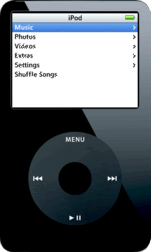
ipodThe unparalleled success of the Apple iPod is quickly becoming design legend. Not only is the iPod internationally known as the coolest gadget worth stealing, but those in the design community can’t stop talking about it. Not only do I hear the iPod talked about by industrial designers, but all types of designers. Web designers, interior designers…all feel the gravitational pull that seems so easy to transfer to designing other media. They’ll say: “We want a simple, clean design, like the iPod”. Never mind that the iPod is a physical product that plays music, it is widely believed that its magic can be transfered to all disciplines of design, aural or otherwise.

Of course, the situational context that brought the iPod into being will never exist again. Never again will an atmosphere exist like the one in the late 90s. Never again will Apple be able to fly under the radar of the music industry. Never again will huge competitors laugh at Apple for making a small, silly device with rounded corners and a click-wheel.

But that doesn’t stop nearly everyone from using Apple’s success as the ideal example of design done right. If we only look to the iPod for design inspiration, we can come up with the super simple, super sell-able design that everybody craves. There isn’t a Powerpoint presentation in all of the design world without a slide dedicated to the white, beautiful, yet unreplicable, iPod.

The problem is that the iPod in an incredible outlier. It’s not necessarily a one-hit wonder, but it is such a big hit that no other product from any company can expect to perform similarly, not even the iPhone. The iPhone, of course, enjoys some of the best buzz in the world, and it hasn’t even been released yet. But even with the incredible talk surrounding it, there is no way that the iPhone can be as successful as the iPod, as it enters an existing, relatively mature market. The iPod has 70% market share. The iPhone will be lucky to grab 5%.

Not only is the product an outlier, but Apple is unlike any other company. First of all, it is 30 years old, which immediately sets it apart from most companies. It has had all that time to build up the amazing array of designers it has, learn what works and what doesn’t, and invest huge amounts of money into technology that most design firms could only dream of. Imagine what they’ve invented that has never hit the light of day. Even the return of Steve Jobs was a decade ago…an incredibly long time.

The iPod is a great case study, but it’s not replicable by any standard means. Microsoft’s attempt at doing so, the Zune, is hardly a blip on anyone’s radar. And that came from a company who had years and years and more money than anybody to throw at the problem. A better strategy might be to build whatever is the opposite of the iPod. Then, at least, you don’t have impossible expectations.

Less than a decade old, the iPod will endure as one of the best industrial designs ever. It is well-deserved. But as far as showing everyone else the way to design, it does more to blind us than help us see more clearly.

Comments ( 16 Responses so far )

1.  David Malouf on April 30th, 2007 (Comment) #

Great piece,
I think the Peter Me put it really well recently when he said something like, everyone wants something like an iPod, but no one is willing to put the same time, energy and money behind how the iPod or any Apple product is created:

1) internal cultural change
2) really long design lifecycles
3) moving from widget to system design
4) clear design vision and strategy lasting in terms of a decade, not a quarter
5) willingness to alienate some today to win others tomorrow
6) strong belief in control

Sure, I can design for you the next iPod, maybe, but are you willing to do what it takes to let me succeed?

2.  Krishna Kumar on April 30th, 2007 (Comment) #

Every major success story has the same problem. People don’t see all that went into the making of that success. They just take 1 or 2 major factors behind the success and try to follow that. Most imitations fail for this same reason.

3.  Capt. Kirk on April 30th, 2007 (Comment) #

Just read this: What If Apple Is Bad for Design?

I’m unsure if I get to the point of the author, though.

4.  ~bc on April 30th, 2007 (Comment) #

there is no way that the iPhone can be as successful as the iPod… The iPod has 70% market share. The iPhone will be lucky to grab 5%.

It depends on your metric for success. Also, 5% of the world phone market (at $4-500/ea) might be as successful as 70% of the digital audio player market. Heck, some people might call the iPhone a success right now, considering it’s current mindshare. It’s market needs a disruption anyhow.

5.  Snafu on April 30th, 2007 (Comment) #

Well, that page seems to be warning us not to confuse design with style, and I concur: many Apple products look great, but show serious design issues. Design is about solving problems, not about just looking good and being somewhat easy to manage.

6.  Snafu on April 30th, 2007 (Comment) #

(Although the writer concentrates on the style issues, curiously. Strangely, I would have criticised the fact that there are easier shapes to handle than a beveled brick)

7.  John Koetsier on April 30th, 2007 (Comment) #

Great post, and a typical problem: we see the product of others’ labor, but the process is largely invisible. We want the fruits, but we forget the roots.

8.  Al on April 30th, 2007 (Comment) #

Most people miss the fact that the iPod is more than a sleek gadget. The iPod is the delicate mix of an integrated MP3 player, iTunes software that gets music from your CD collection to your iPod very easily and iTunes Store with it’s one click music, TV show, and Movie purchase and audio and video podcast access. The itunes software gets anything in your collection to your iPod seamlessly.

The iPod design helped but the ease of use of the whole iPod ecosystem is what gave Apple the huge market share. It is not just industrial design but the blend of good design and well designed, intuitive software.

At 70% market share, Apple has sold over 100 million iPods in 5.5 years. The yearly global market for cell phones is 1.6 billion. If Apple gets a 2.5% market share for iPhone, it will be selling more iPhones than iPods per year. That is doable and that is another big hit. Bank on it.

In case anyone asks, Microsoft’s share of the cell phone OS market is less than 0.5%. Apple will pass Microsoft’s cell phone share by next January.

9.  pauric on April 30th, 2007 (Comment) #

“You can’t depend on your eyes when your imagination is out of focus”
Mark Twain

10.  Andrew on April 30th, 2007 (Comment) #

“Of course, the situational context that brought the iPod into being will never exist again. Never again will an atmosphere exist like the one in the late 90s.”

Now wait a minute. Are you speaking here of the context of “digital music players” or of “technology in the 90’s” in general? Sure, you’re probably right about the first, but certainly not about the second. Of course there will again be a moment like the 1990’s: there will again be a time when some personal technology moves from the margins to the mainstream, possibly disrupting old industries in some unpredictable and fun ways. We will all lose our shirts in some future bubble again.

11.  jharr on April 30th, 2007 (Comment) #

It seems like a more common theme is developing here, basically since Apple’s done well the only way to succeed is to be contrary and do the opposite, you even said so in this post. That just seems short-sighted and a bit ‘bandwagon’ to me. I think understanding why the product was successful (tremendous innovation, hard work and a keen sense of reading what consumer want) and also understanding the market and other forces that you can’t control give you a pretty clear path to travel down if you want to have similar success with another product.

The Zune didn’t fail because it was too much like the iPod, it failed because it was too much like Microsoft - developed by committee and watered down to the point it had no soul left, took no risks. Innovation is the key, if it’s not really changing the way people interact with the world it won’t ever capture marketshare like the iPod. That goes for the iPhone as well, although the mobile phone market is a very different beast and Apple’s entrance into it is well behind the curve, with the right mix of innovation and style they may surprise us all.

12.  Shahar on May 1st, 2007 (Comment) #

Nicely put. If anything, apple has shown that interfaces can have ‘breating space’, be simple and remain very usable. That’s something to take inspiration from, but not copy.
(Maybe that’s, or somthing like it, is what customers mean when they say “Make it more like an iPod”?)

13.  Johan on May 1st, 2007 (Comment) #

Apple has a different working culture than e.g. Microsoft as in “more open”. This is an advantage since the developer of the ipod interface software gradually developed simple and reusable blocks of software for the iPod (mobile devices) and in 2001 iPod hit the markets. It would not be a hit if the mac did not support firewire (fast uploading files). Again, the hardware was doing a fine job at the time though Apple’s hardware development and innovationd epartment was very slow during the late 90s. The navigation of the ipod is dead simple, and is just doing what iPod supposed to do: navigation through music files. Added, the design of the ipod was done seperately but suopports the software UI design well.

14.  Michael Camilleri on May 2nd, 2007 (Comment) #

Of course, the situational context that brought the iPod into being will never exist again. Never again will an atmosphere exist like the one in the late 90s. Never again will Apple be able to fly under the radar of the music industry. Never again will huge competitors laugh at Apple for making a small, silly device with rounded corners and a click-wheel.

I’m not sure if I can entirely agree with this. Although there’s a lot of buzz about the iPhone in a way there wasn’t with the initial iPod I do believe that in its creation Apple has: a) managed to fly under the radar of the mobile phone industry and b) had its competitors laugh at why anyone would want to pay $500 for a phone that doesn’t even have a keyboard.

As posters above have pointed out, if the iPhone is even moderately successful in the absolutely huge cell phone market Apple stands to sell a lot more iPhones than it did iPods. In the sense that the iPhone won’t rescue Apple from obscurity, you’re right that it can’t replicate the iPod. In the sense that it may be to mobile phones what the iPod was to the Walkman, I’m not so sure it won’t have a similar sized impact.

I accept, however, this wasn’t really your point. What you seemed to be getting at is that using the iPod as the one-size fits all design analogy often obscures what the real solution should be. The iPod is a great example of how software and hardware should work together but there are problems it can’t solve. I don’t like the way newspaper web sites are designed. Should they be designed more like the iPod? Well what the hell does that even mean? Analogies are fun and sometimes even helpful but one does need to be careful, especially when using the iPod, seductive though it may be.

Pingback: Zune : Blinded by the Apple iPod

Pingback: barcode :: Lungo silenzio… :: May :: 2007

Add Your Comment

Accepted tags: <a href="" title=""> <abbr title=""> <acronym title=""> <b> <blockquote cite=""> <cite> <code> <del datetime=""> <em> <i> <q cite=""> <strike> <strong> .

Preview...

If your comment contains links, or if it is your destiny, your comment may not show up immediately. I'll approve it as soon as I can. (I delete dozens of comment spams per day)

Get updated when someone posts a comment: Comment Feed


ABOUT

Bokardo is the blog of Joshua Porter, a web designer/developer, researcher, and writer. I live in Newburyport, MA, USA.

WHAT IS SOCIAL DESIGN?

Social design is design that focuses on the social lives of users. It deals with the activities, behaviors, and motivations of people who work and play together through software interfaces. It is built on the observation that many of the decisions we make are greatly affected by those we surround ourselves with in our social lives: our family, friends, and colleagues. Exploring our motivations and how to design interfaces to support them is what the Bokardo blog is all about.

Designing for the Social Web

Building a social web site or application? I wrote a book just for you!

designing for the social web

Find out more or order from Peachpit or Amazon

Upcoming Speaking Events