A Self-Referential Demonstration of the Power of the Del.icio.us Folksonomy
If you haven’t yet checked out del.icio.us, you should. Here’s why.
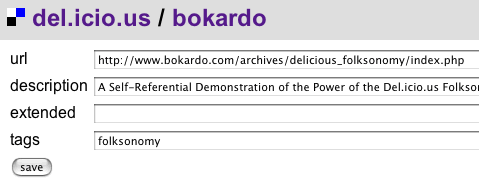
Del.icio.us is an online service that allows people to store bookmarks of web pages. To create one of these bookmarks for a page that I’m reading, I simply select a bookmarklet that del.icio.us has provided for me. When I click on the bookmarklet, I’m taken to a form within my del.icio.us account, pre-populated with metadata from the page I was viewing. Then, I modify the metadata by tagging the page with some meaningful word, such as “folksonomy” and save it to my collection.
Over time, I add more bookmarks and my collection grows. I’ve had my collection for a couple weeks, and you can see it here:
Lately I’ve been reading a lot about folksonomies, though, and building up a bunch of bookmarks that I’ve tagged as “folksonomy”. This is what my folksonomy collection looks like:
http://del.icio.us/bokardo/folksonomy
For those programmatically inclined, there is also a feature to get these bookmarks in html form, so that you can embed them on your site, for instance. (I’ve embedded my folksonomy links in the Further Reading section below this article.)
Even better than viewing my collection of “folksonomy” bookmarks, Del.icio.us provides information about how many others have tagged those pages as well. I can tell how many people have tagged them, and what words they used to tag them. Here is what that looks like:
http://del.icio.us/tag/folksonomy
If you’re not excited by this, you must not like discovering new things. Del.icio.us not only keeps all of your bookmarks within reach (you can even get RSS feeds of most del.icio.us page types), it just did a whole bunch of real-time research for you on the topic of folksonomies. They even weighted each result with the number of people who tagged the page “folksonomy”, giving you some feel of how relevant each source is.
Now all you have to do to find out what folks are talking about (a great indicator of quality content) is to go to the del.icio.us URL created from the word you’re interested in.
It will be in this form: http://del.icio.us/tag/tagname
Here are some more examples:
- http://del.icio.us/tag/mac
- http://del.icio.us/tag/webdesign
- http://del.icio.us/tag/webdesign+folksonomy
This is the power of folksonomies. Personal tagging, behavioral aggregating, serendipitous discovery.
NEW: the code to dynamically import bookmarks from del.icio.us. Note: this is not the best way to do this: if you can, cache the results and update them only periodically from the del.icio.us server. (I’m working on a solution myself – any help or insights appreciated)
<?

$ch = curl_init();

curl_setopt($ch, CURLOPT_URL, "http://del.icio.us/html/bokardo/folksonomy");

curl_setopt($ch, CURLOPT_HEADER, 0);

curl_exec($ch);

curl_close($ch)

?>
Also, del.icio.us isn’t the only service like this. Furl, Spurl, and Technorati all have similar functionality, too.
