November 9th, 2005
Why Should I Trust Microsoft with My Attention Metadata?
Update: Robert Scoble has addressed my question in a post this evening. He says that I’m asking the wrong question, but then goes on to say that Microsoft should become more trustful anyway…(so apparently my question wasn’t completely wrong). It is certainly the right one for me, anyway. I think I get his point, though…that trust is a huge deal and it’s not just about Microsoft…and I agree completely. (That’s why I’m asking about storing attention metadata locally, as you’ll read below)
Who would you rather have keep a database of your attention metadata: Microsoft or a complete stranger?
For me the answer is easy: not Microsoft.
You see, Microsoft has so damaged my trust over the past decade that I won’t consider them as a viable alternative for anything until they’ve proven to me that they’re sincere about making the World a better place, one that includes customers as desirable people for whom they want to do great things. Forget better software, forget innovation. I never once considered them as a potential keeper of my financial information with their Passport initiative, and right now, with their latest release of Windows and Office Live, all I see is that they’re trying to create more tie in for me to wish I was out of.
And it’s not just that I like Apple’s products better. It’s that I trust Apple Computer to not screw me over. I have a small personal budget to spend on hardware and software, and I’ll gladly give it to the company who I trust the most. When I go into an Apple store with a question or problem, I’m treated as if they want me as a customer. At the end of the day, it is this that keeps me there. You only feel tied in to something that you want out of.
So instead of Microsoft, would you give your attention metadata to Root.net, an AttentionTrust approved service? (more about AttentionTrust here)
I have been giving my attention metadata to Root.net for the last few days, and I must say, it’s a very cool web application. After writing about the trust I decided to become a member, not because I’m dying to give my attention metadata to someone else but because I wanted to know how it all works.
Here’s a quick synopsis of the steps to do so:
- Sign up for a Root.net Vault account
- Download and install the AttentionTrust Firefox plugin
- Restart Firefox
- Change the AttentionTrust Recorder setting so that it sends my attention metadata to Root.net
- Browse around like you normally would, allowing the plugin to gather your attention metadata
- Go to your account on Root.net to see what they’re collecting
(By the way, if you don’t change the setting to send your information to Root.net, it will store the information on your hard drive anyway.)
Here’s a screenshot of what my Vault account on Root.net looks like after a couple days of sending my information there:
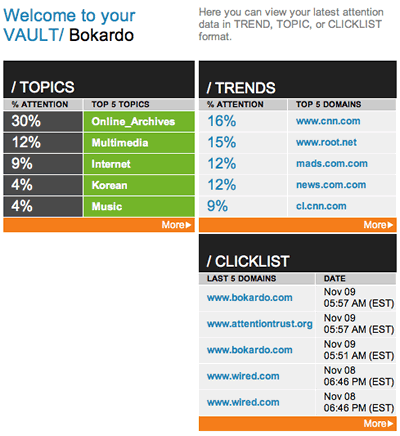
You can see that my attention has been recorded along 3 axes:
- Trends
Let’s start with the trends, because we can easily see what it is tracking. You’ll notice that my time was mostly spent on 5 different domains: cnn.com, root.net, mads.com.com, news.com.com, and cl.cnn.com. The problem is that I never visited two of the domains (mads.com.com and cl.cnn.com). These domains simply served up ads or served as passthroughs for the domains that I was on. - Topics
The topics are pretty confusing to me. The sites I went to (CNN, News.com, Root.net) don’t seem to be related to these topics at all, although I noticed that “Archives” showed up as I was browsing CNN. This needs some more explanation. Also, I noticed that this here blog shows up under the Topic of “Literature”, and I chuckled. Jorge Luis Borges writes literature. I write a blog. - Checklist
Checklist is simply a list of the URLs that I that accessed.
Put together, this is a sliver of my attention metadata, and even though it only captures my surfing behavior over time it would be a LOT of data!
But the question remains: do I feel comfortable storing my attention metadata on my Root Vault account? They’ve pledged to be good about it, and their application, though it’s still getting its legs, is very interesting and I didn’t notice a slowdown in browsing. But why wouldn’t I just store it locally and wait until the attention market matures instead of storing it elsewhere? Is there a benefit to storing it elsewhere?
Imagine, for example, if someone sold their attention metadata tomorrow for $40.00 to some company who wanted to use it to better understand their target population. That would certainly change things for the day after tomorrow, as large numbers of people would then clamor to sell their attention. But I also imagine the speed and veracity of people creating fake attention metadata to sell as well. There will have to be some verification function built into all of this.
In his Disruption Gang podcast, Steve Gillmor, President of the AttentionTrust, leads a very interesting conversation about how important attention metadata is becoming.
Here’s my interpretation of the issue as discussed in the podcast: Search has worked in the last few years because we can approximate what people pay attention to by looking at what they link to. This worked very well because it allowed Search engines to give very relevant results by assuming that what we pay attention to is valuable.
However, this doesn’t work perfectly. In the longer term, this only shows us an average value of things, not a personal value (as I wrote about). Combine this deficiency with splogs and millions of false links, and the noise starts to drown out the signal, and Search begins to suffer (as well as the advertising goldmine that is associated with it)
To improve on the “linking means attention” idea we would need a better way to measure attention. This is what the Attention Recorder attempts to do, even though its reach right now is limited to our browsing habits only. (a great start nonetheless). Eventually they’ll probably add other axes of attention, like who our contacts are, who we chat with, who we email, etc.
The most interesting bit of the podcast, however, was when Robert Scoble, the attention bunny, said that he was fighting for Microsoft to take the lead, join the AttentionTrust, and make attention metadata a high priority within the company. He sees it as a very valuable place to be in the coming years.
Doc Searls agreed, saying:
“I think there is enormous room to reinvent advertising, and I think attention has enormous promise there and if I were Robert (Scoble) I would go to the people at Microsoft and say ‘Look, you want to beat Google at the game where they’ve leapfrogged the whole entire advertising industry, leapfrog them again with something that gives people what they know they want…and attention has that promise’”
That’s a pretty bold claim. Let’s assume for a moment it is true, and attention is all it’s cracked up to be and Microsoft tries to take the lead…why should I trust Microsoft with my attention metadata when I don’t trust them with anything else?
Links to this Post
Comments
1. Ed Batista 12:33pm, Wed 9th, 2005
Great post, Joshua. I just followed Greg’s lead and pointed to it from the AttentionTrust blog. Would love to hear further feedback on your experience with the Recorder and Root Vaults. Thanks–
Ed Batista
Executive Director, AttentionTrust
2. Mahmoud 6:11pm, Wed 9th, 2005
Joshua,
What is the difference between Root Vault and the Google Search History? I am pretty sure, Google collects the same information for their own use in the future. Especially making the search results better. Am I wrong?
3. David 9:47pm, Wed 9th, 2005
Why don’t you trust them? You never actually state why. I ask because I do trust them. Can you give some specifics?
4. Xboxer 4:09am, Thu 10th, 2005
very true David…I trust Microsoft as well, I for one have never had any problems with their products and even if I did, trust is not about problems with products…
u trust Apple so much because they treat you real nice at their customer support centre? give us specifics: why do you trust Apple over Microsoft or Google over Microsoft?
5. Xboxer 4:13am, Thu 10th, 2005
one more addition:
since trust is not about products and problems I’ll tell you why I trust Microsoft over Google/Apple and others…
Microsoft is damn open…and you can’t argue with that…we KNOW of ALL problems in development, business etc that MS has gone through…we know what they’re developing and how they’re developing it…heck we know that there was a Vista reset…we only know about Apple’s decision to do something when Apple feels like enlightening its followers…and Google is a completely different entity…nobody knows anything about them…
so how do you build trust…like Scoble says: be MORE open…
6. Srijith 4:32am, Thu 10th, 2005
The Root.Net service begs a bigger question. Why does my (very personal) data have to be at a machine that I do not control. What functionality does Root.Net provide that makes it important for me to offload the data to them? Why can’t they release a version of their code and plugin that allows me to intall it on my server and get my data to be analysed by my machine?
It is not like they are providing a service (read del.icio.us) that exploits (as in from my point of view, not their) the power of the crowd.
7. Josh 9:10am, Thu 10th, 2005
Thanks for the questions, guys. I understand that you have a lot of trust in Microsoft. Here’s why I don’t:
First of all, I’m a web developer and Microsoft has a clear history of diverting from web standards in an attempt to create their own web monoculture. The number of examples is astounding. This is changing with the work that Molly Holzschlag and WaSP are doing with the IE 7 team, and while it’s a good thing, it’s many years too late in my opinion.
Second of all, the monopoly thing. Why should I trust a convicted monopolist?
Third, the appalling user experience. About a month ago I tried for over 8 hours to remove viruses from a infected Windows laptop, and I got so frustrated that I had to let my sysadmin do it. I can’t really say that I trust a software maker who ignores for years the amazing amount of trash that propagates on their systems. Every time I have to “reboot” I frown…not just from the wasted time but from the contrast to the other two solid OSs. Of course, your mileage may vary here, but I know many folks who are experienced computer users who go through this.
Fourth, I believe in open document formats. I believe that tools to write open document formats are where innovation should lie, not in the formats themselves. Microsoft have shown that they don’t hold this opinion. They bully governments into using their tools, and that’s simply wrong.
Fifth, when Steve Ballmer says that MS are going to “crush Google” and continually focuses on corporate competition, that signals to me that he doesn’t care about his users. If he did, he would keep his mouth shut and focus on building better products.
Sixth, there are better alternatives. When I walk into an Apple Store or call an Apple support specialist, I’m treated as if they want me as a customer. There have been several cases in the last 3 months alone where Apple have taken a loss at their own expense because they were trying to make me a happy customer. That’s really hard to ignore.
In general, though, it’s really hard to trust a company whose products I don’t use for technical, political, or competitive reasons. It’s kind of like the way I look at Walmart. I *could* buy all my stuff there, but I choose not to because I don’t trust them to do the right thing. I’ve been on the Web long enough to realize that there are alternatives out there, and there are people who try to do the right thing, even if it means a loss of control.
8. David 12:51pm, Thu 10th, 2005
Thanks for replying. It seems most don’t apply to me (not a developer, no viruses, etc.) The monopolist one does apply to me although I think what you mean to say is that they were convicted of abusing their monopoly. It’s not against the law to be a monopoly. But I’m not entirely sure how that affected me. I’ve felt I get a decent deal on their OS compared to other software. And I’ve always felt I’ve had other options (e.g., Macs which I’ve owned). I don’t feel they always make decisions in my best interest but I do feel like I always have other choices if I don’t like those decisions.
The main reason I trust them is because they are so big and so highly scrutinized. I generally trust larger corporations because of the attractive economics of class action suits. If they did something with my data I think they would be screwed. Anyway. Another perspective.
9. Richard Moriarty 2:45pm, Thu 10th, 2005
The thing about big corporations is that they have more resources to put into a legal issue than some angry class action lawyers. It’s a joke to think Microsoft should be trusted because we have a legal system.
Also, the things that we do with our computer are becoming less sacred. Sony took a jump very close to the “virus line” with their rootkits, which they, and I imagine others, just consider to be the natural extension of DRM.
In the future, any big company probably will find a way to prove that they own your data because you use their service.
10. Robert Scoble 7:04pm, Thu 10th, 2005
Josh,
I hear you (and, if you and I were having a beer right now, I’d even agree with you).
A couple of things: yes, we have really screwed over the Web. No doubt about it. It isn’t so simple, though. I was an IE user back in 2, 3, 4, 5 because IE supported more standards faster than Netscape did. Remember CSS? Who did that first? Microsoft. Remember DHTML, er AJAX? Who invented that?
Regarding UI. Have you seen Microsoft Max yet? Anyone who has can’t say we don’t know how to make awesome user experiences. Or, check out Sparkle.
Windows Vista fixes most, if not all of the other things you’re complaining about. Is it late? Yes. I wish it were out by now too.
Regarding monopoly. 85% of our referer hits to http://channel9.msdn.com are from Google. So, you’re saying you can’t trust a monopoly with your attention data, right? Well, 85% in most people’s minds is at minimum dominant and is definitely moving into the line of a monopoly. When we were convicted of being a monopoly we had about a 90% market share.
Fourth: the last chapter has not been written on open data formats. It’s my prediction that all of our formats will be very open by the end of next year. Far more open than you might think or believe. Keep watching us on that one. The era of closed formats is about to end.
Fifth: I agree. Although a lot of that is just Steve’s personality. Do you watch Jim Cramer of Mad Money? A lot of that is the same kind of bravado. Sometimes you need that kind of bravado. Sometimes it hurts you. Here I agree it hurts more than helps.
Sixth: I agree. I hang out a lot in Apple stores. They are awesome. But don’t miss that you have to pay for that kind of service. Also, I get that same kind of service at Best Buy. I had a camcorder go dead and they took it back. Another time I just didn’t like it. They took it back and gave me a full refund.
11. Josh 7:12am, Fri 11th, 2005
Thanks for all the comments, guys. I’m really digging this conversation, and I really think that it’s best for all parties to do it without flaming. Microsoft can only benefit from an honest conversation about things.
Robert, you are a great evangelist for Microsoft. You argue with passion and honesty, and that’s awesome. I posted many moons ago about that, and I still think so. For my part, I think it will be a while before my opinion of Microsoft starts to change significantly enough for me to consider buying your products, but I can say that your efforts here and daily on your site are certainly a step in the right direction.
About IE. I agree, IE in the 4 days was the best browser out there, and insofar as it supported standards I was happy with it. Now Firefox and Safari are superior, and one thing that I really appreciate about them is that they support standards no matter what, and continually innovate. Dave Hyatt and gang just released a browser that passes the Acid2 test and that signals to me that they care about developers. The IE team only got back on the horse when their broken browser was being beaten. From a business standpoint it probably makes sense. From my standpoint as a developer, it’s frustrating as heck.
I’ll definitely check out Max and Sparkle. Thanks for the pointers.
And finally, hanging out in Apple stores might be the best thing that Microsoft employees could do. You’re an exception to the rule there, I bet. Further, I think it can only benefit the end user that companies like Apple, Google and Yahoo are firing on all cylinders now, and it’s bringing back some competition that all parties desperately need.
12. Jonas Goldstein 11:46am, Fri 11th, 2005
Hi Folks
I am one of the founders of /ROOT as well as Attention Trust. In addition to helping establish models and principles for each of these entities I am doing much of the product definition and design.
Writing here because I am delighted to see a conversation hybrib between privacy, security, standards, and UI. I specialize in customer experience design and HCI, but have spent much of the last 4 months thinking about the intersection of these other issues because of what /R and AT have evolved into.
If you go to the current root.net page you may find that it is different than when you signed up. We have pushed the /VAULTS down one level to expose the greater challenge we are addressing…how can we create an OPEN market place for the pricing and exchange of consumer data.
The message here will putoff many, and may compel current /VAULT owners to immediately login and “DELETE ALL”. We understand.
But, if you spend another moment with the principles of AT (property, mobility, economy, transparency), and reference this against the idea of a transparent exchange for attention data you can begin to see how this changes the game.
/ROOT aims to help its users understand the value of their attention data, and how it is a truly valuable expression of their digital identity.
Part of our consumer strategy is to enable users to pay attention to their attention. if attention is currency, this would be investing in yourself…believing that you are interesting. All the tools we are developing for consumers aim to convert their attention to influence, and provide a platform to leverage this influence.
What you currently see in our /VAULT product is the beginning of the beginning…we simply wanted to get something out there that works (even if topic assigning through DMOZ is horrible)
All /ROOT product development happens on top of our corporate values…my favorite is “fail fast”.
Please stick with us as we build these /VAULTS. We develop in an agile environment, and have engaged some of the best product designer/developers out there. We have a laundry list of features and functions that will surely delight all Attendees (does that term work for those who pay attention to their attention?)
So, thank you Josh and Robert for opening a /VAULT.
I hope the time you have SPENT, and the attention you have PAID will be properly converted to currency in this new marketplace.
13. Jeff Watkins 2:35pm, Fri 11th, 2005
Xboxer and David seem skeptical that Microsoft’s monopolistic practices have impacted them in any way. The worst part about this is you have no idea how much these practices have diminshed the vibrancy of the software market.
During the 7 years I lived in Seattle and worked in the software development world there, I attended countless product development brainstorming sessions from formal meetings with investors all the way down to a couple developers sitting around in a bar scratching ideas on napkins. I’ve lost track of the number of times really great product ideas were abandoned because the principals feared Microsoft would kill them.
In one case, a friend’s company developed products that worked with the Exchange mail server. Once his company started seeing real revenue, Microsoft began to take notice — they told his customers that the next version of Exchange would include all the features from his product. When the next version of Exchange shipped (late as usual), it had but a quarter of the features. However, the damage was done: his customers hadn’t bought the product because they were waiting for Microsoft.
Finally, my experiences actually working for Microsoft in late 1995 solidified my absolute disgust for Microsoft’s business practices which included at the time withholding API documentation from their partners so that their products could appear to have an edge.
My positive experiences as an Apple customer aside, there’s no way for Microsoft to earn my trust.
14. esports 12:34pm, Sun 18th, 2007
I don’t think that i ever trust Microsoft Corporation
15. pusha 12:21pm, Thu 8th, 2008
In general, though, it’s really hard to trust a company whose products I don’t use for technical, political, or competitive reasons. It’s kind of like the way I look at Walmart. I *could* buy all my stuff there, but I choose not to because I don’t trust them to do the right thing. I’ve been on the Web long enough to realize that there are alternatives out there, and there are people who try to do the right thing, even if it means a loss of control.