Sermo a sign of a larger trend toward specialized social networks

by Joshua Porter  |   20 Comments  |  shortlink: http://bokardo.com/p/668

Jessica Vascellario has written an interesting piece at the Wall Street Journal: Social Networking Goes Professional. It describes a professional social network for doctors called Sermo.com, where doctors share information on treatments, diagnoses, and other medical topics.

sermo

The Sermo demo video (worth watching) asks “Why consult one colleague when you could consult thousands?”. Of course, to ask this is to assume that all of those thousands of colleagues actually know what they’re doing: they’re not fraudulent doctors who make stuff up. The way Sermo solves this is by verifying every doctor who signs up against a database of licensed physicians…so it is open to anybody, as long as you’re a real doctor. This will help to keep the system at some basic level of professionalism.

Sermo is a sign of a larger trend: the move to smaller, more specialized social networks that have custom tools to support a unique activity and may cater to a private or exclusive set of users. In this case it is sharing medical information among verified doctors. But there are many other specialized networks being built, as the journal’s graphic depicts:
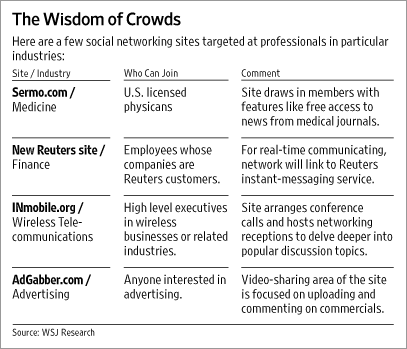
Wisdom of Crowds

My hunch is that we’ll see a lot more specialized social networks coming soon. They’ll support a unique activity and user group in ways that generic software can’t, as well as provide the appropriate privacy and membership tools to keep them high quality and relevant.

Update: Several folks have pushed back on the idea that these sites are anything new…or anything beyond the forums of the 90s. The difference is that they are now social web applications, offering tools to rate, review, track, and otherwise record various parts of activities that we didn’t have before. Another big difference is that some are person-centric as opposed to topic-centric (as in forums), so different relationships are formed, you can make connections, friend someone, follow someone, etc. All of these services are slightly different, however, but I do believe there is a general trend…

Check out my latest project: Make them Care!, a book on designing great sign-up experiences. Get reminded when it's published.

Links to this Post

Comments

1.  Alex Mather 11:54am, Tue 28th, 2007

Great demo but is it just me or is Sermo a message board with polls? I like the idea of specialized “Social Networks” but I think the value comes from features that are unique to the vertical.

2.  Pauric 12:12pm, Tue 28th, 2007

Two points, first.. I got a monster.com mail that had a Sermo position open for a designer.

Second, in line with Alex’s view… I believe some of the Boston hospitals have forums/support groups for patients (mostly chronic illnesses)

So, are ’social networks’ essentially just web 2.0 forums?

Yes, there’s some unique features and ‘connecting’ etc. But strip all the bells & whistles away, what makes a social network more than a forum?

3.  Adam Darowski 12:30pm, Tue 28th, 2007

I did a bit on Sermo a while back called How Social Media Can Be a Corporate Pain in the Ass. While they are essentially a forum, the key to their network is the exclusivity of the users—the only people allowed in are experts. And you gotta love how disrupting they are to the established pharmaceutical industry.

On the other side of the medical spectrum, I’ve spoken with a few folks from Boston-based PatientsLikeMe, another example of a specialized social network. They are a network for the patients. I love that instead of Amazon’s “customers who bought this also bought this…” intelligence, they have “patients at the exact same stage of ALS as you who are experiencing these symptoms that you are have taken these medications and felt these side effects.”

Ridiculously amazing.

The market of “just because” social networks is now bloated. In order to take off you’re going to need one of these specialized networks that offers something nobody else can. One key to that can be taking detailed profile data and using it to help foster your users’ social interactions (like PatientsLikeMe, and others such as last.fm).

4.  Get Enspired 1:23pm, Tue 28th, 2007

I believe smaller vertical social networks are the next wave. These networks will not be limited to boards, forums, and polls, but will include specialized tools highly targeted to the demographic in which they serve.

These sites will understand the unique characteristics of their market better than the behemoths, and they will use the social networking tools that are proven successful (video, tagging, commenting, contacts) and make them highly targeted to their users.

5.  Josh 1:49pm, Tue 28th, 2007

Thanks for the link, Adam. Great stuff…hadn’t heard of PatientLikeMe before, but it looks, like you say, ridiculously amazing.

6.  Marty Alchin 1:54pm, Tue 28th, 2007

I find this very interesting, but I disagree with your notion that this is a trend to move to smaller, more specialized networks. Such networks have been available on the Web for nearly its entire existence, so I’d hardly call this a new concept. What seems to be new about it is twofold.

First, it’s built for professionals, where nearly all established specialty networks are for hobbyists (such as LUGNET). Second, designers and developers are starting to add a richer set of social features (learned from more generic sites) to these specialized networks.

I expect that, in addition to an influx of professional-oriented specialty networks, we’ll see a significant upgrade in the feature sets of existing hobbyist networks.

7.  Erkko 1:57pm, Tue 28th, 2007

These networks will actually create an interesting business opportunity for the hosts. The information created by 3 of the 4 mentioned networks in joshua’s post will accumulate valuable and monetizable content. Interesting!

8.  Adam Darowski 3:52pm, Tue 28th, 2007

@Erkko: That’s the thing. These broad social networks have to deal with a lot of advertising that just doesn’t matter to them. The more specialized ones can have more relevant advertising (think Dogster) or maybe even no advertising if they allow their profile info to be sold.

9.  Marshall Kirkpatrick 9:11pm, Tue 28th, 2007

Great post and comments, esp Adam’s. I think the web could use a really great post on what makes social networking a unique phenomenon. identity plus sel publishing plus “friending” and subscription all rolled up into one site. now give me open ID and appropriate data portability!

see also appscout.com post on nanoscientist network too btw. if not on my phone right now i’d add link

10.  Mike H 9:36am, Wed 29th, 2007

As a regular reader of this site and a UI designer at Sermo, I’m quite interested in this topic :)

To clarify the question about differentiation, one big difference with Sermo is the unique business model: physicians get free anonymous membership, and clients in the financial and healthcare industries pay for access to aggregated voting data and physician commentary. There is no advertising, and no plans to add it.

There was a recent blog posting somewhere about social networking sites being short-lived: first everyone jumped on MySpace, then abandoned MySpace for Facebook, etc. I have a feeling that for specialized social networks this is not the case.

11.  Marty Alchin 12:15pm, Wed 29th, 2007

@Mike H:

I wholeheartedly agree with you regarding the sustainability of specialty networks. Looking at the history of existing sites, it’s clear that users who flock to a focused site will be much more likely to stick with that site than to abandon it when something else comes along.

I think that notion owes much of its credence to the importance of a specialized community. Generic social networks seem (to me) to focus more on social networking features than on developing a meaningful community. So when a new site comes along with new or better features, people move on, because the community they’ve established is secondary.

In a specialty area, users connect on a far more specific level, which allows them to place more value on those relationships, and they become unwilling to lose them.

This, in turn, makes it much less likely that future competing sites will even show up, since they’d have a lot of “social inertia” (think the object at rest staying at rest) to overcome. That’s why I expect new features to be added to existing specialty networks, since the communities can remain intact, while entering into this brave “new” world.

Thinking about social inertia makes me want to form even more physics analogies to social networking, such as relationships having mass and what not. Maybe I’m just too geeky for my own good.

12.  David K 12:59pm, Wed 29th, 2007

The core value of any network is ‘topic relevance.’ ‘People’ are secondary, but it is up to them to supply quality topics and content to support those conversations.

You join a group for which the topic is one that you can relate to. Make that group’s topic the focus of an entire website, and you have a very valuable arena with highly concentrated conversations.

So yes, this is just repackaging a pretty straightforward concept. But the tools have evolved, and, more importantly, the trends have evolved to make a more comfortable experience of using the net as social media. Early adopters will gravitate to the focused social sites. Late adopters are more likely now than back in the 90’s to lurk and possibly interact.

So the concept of the medical professional network? Great! The business around it? Well…that’s another story.

Based on Mike H’s comment, there is no intention of selling advertising to the network. My money’s on “Not Yet.” It’s easy to get a network; it’s getting them to talk that is the hard part. So selling to lurkers seems like a logical plan B. Selling aggregate information to financial and healthcare companies, as they are doing now, means that you are defining and monetizing the trends based on your active community. Which means that community best be fully active. I would hope that Sermo stays true to its integrity by not including key brands in its polls nor leading questions in its questionnaires.

I believe in the concept; I just don’t see the money in it – especially in a space with a TON of money to spend.

13.  Mike H 2:37pm, Wed 29th, 2007

On general vs. specialty sites:

I think one problem with the more general sites is the implicit assumption that you will want to have ALL your photos, music, blogs, friends etc. hosted there — there is little interoperability with other sites. It’s a sort of AOL-style walled garden all over again (with slightly shorter walls).

Contrast with the Flickr model, where the scope is limited (only photos), but it’s well integrated with a lot of other places on the net–you don’t need to worry about having nine different places to keep your pictures and which actions you can take at each site. You can have them in one place and yet still do what you want with them. It’s more of a “small pieces loosely joined” approach.

Overall the general sites are gambling on total buy-in, and they’re just not gonna get it…

Also, the signal-to-noise ratio tends to be much higher on a specialty network (and this is evident on Sermo).

14.  Adam Darowski 3:27pm, Wed 29th, 2007

@ Mike H:

You’re very right (and great work at Sermo, btw).

I just recently signed up for Facebook… on a “why not?” whim. All I’ve done there is add a few friends I”m connected two elsewhere and add widgets for EVERY OTHER SPECIALIZED network I use. What’s the point? I’m better off just having my blog as an aggregator for all these specialized networks (last.fm, twitter, del.icio.us, Flickr, etc.).

15.  asser 3:55pm, Wed 12th, 2007

a ja polecam serwis włosy bo tam są informacje o łupieżu, leczeniu, łysieniu i inne ciekawe sprawy

16.  Auto Parts Jock 3:11am, Thu 20th, 2007

I think specialized social networkings are great. They only suck if you can’t fit yourself into any one. Things like these put the “exclusivity” on social networkings.