Apple’s iPhone and Social Proof

by Joshua Porter  |   15 Comments  |  shortlink: http://bokardo.com/p/638

Unless you didn’t get near any media outlet last week, you probably saw or heard about the thousands of people who stood in line for Apple’s new iPhone. Many major media outlets had reporters on scene, including the NYTimes, BBC, and LA Times.
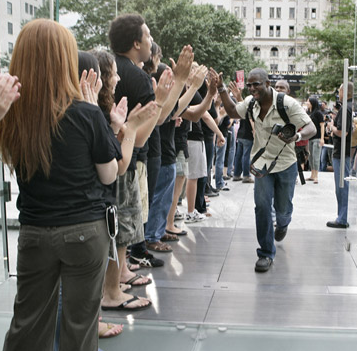
Apple fan enters store

Apple has recorded all of this in the iPhone gallery pages on Apple.com. The gallery shows long lines of both happy and exhausted Apple fans, some staying over night to get a chance to purchase the long-awaited iPhone. They also show banks of reporters with huge camera lenses trying to get a perfect shot of the action. And then they show the relief and happiness of the moment of purchase. These people are true fans, and the gallery depicts them as conquering heroes. One almost gets the feeling of religious fervor when looking at all these images.

Furthermore, the blogging world was abuzz with the iPhone. Not only were bloggers writing about the iPhone every day, but some enterprising folks took videos of their experience. Some even showed the event in real-time.

This is social proof at its finest. Social proof is the idea that in situations where we don’t know what course of action to take (should we buy the iPhone?) we tend to watch and rely on the behavior of others to determine our own. When we see hundreds of people in line for something we assume they must be in line for something worth being in line for. The overall effect is that we start thinking the iPhone must be worth it.

This isn’t a new phenomenon…it’s as old as they get. But what is surprising about the iPhone launch is how Apple is using it to its advantage. Apple knew they had tons of iPhones in stock. They knew that you didn’t have to wait in line for days to get one. But they also knew the power of how that waiting in line would affect those who weren’t, and so they were there to record the whole thing. Now, that excitement is part of their site design…right in the gallery.

We can design for social proof in many ways. Amazon shows its most popular items sold. Techmeme shows the most talked about blog entries. The NYTimes shows the most-emailed articles. All of these features don’t explicitly tell us to buy or do the same as others. But that’s the effect they’re having. When we see so many people going out of their way to do something that we may have been wondering about, it surely makes us more likely to do it ourselves.

So the question is: How can you leverage social proof in your design? Is there an event or activity that your readers/customers/fans are doing that you could record or show to others?

Apple has done an amazing job of leveraging social proof, both in the build up to the launch as well as in the recording and sharing of it. It may not be part of the design of the product itself, but it sure is part of the iPhone experience.

Links to this Post

Comments

1.  Britt Raybould 10:33am, Mon 2nd, 2007

The social proof to buy the iPhone was huge, but I wonder about the post-buy social proof. As people actually get their hands on them do activation issues, frustration with the touch keyboard, and locked contracts lessen that initial proof? Or does the iPhone’s conversation-starting abilities balance the equation? I’m curious to see if Apple has cut short the iPhone’s social proof potential (e.g., going with one carrier).

Like the iPod, Apple’s hoping the iPhone will catch on with the general population, but regardless of the social proof, are there too many barriers to that general population? People didn’t have contracts with previous MP3 players, or worry about the signal quality of a particular network. Apple and Steve Jobs are clearly marketing and design gurus, but it will be interesting to see if this social proof is accepted at the same level as the iPod.

2.  Josh 10:49am, Mon 2nd, 2007

Great question, Britt. I think there will be an adjustment, for sure.

But this weekend almost felt like a movie opening, didn’t it? Hype it up huge so that you at least give your product a chance in the marketplace.

I think that you’re right in that the hands-on experience will eventually trump the initial experience, but surely more people are interested now. But after playing with one myself, I have to say I’m definitely buying one.

3.  mark 10:55am, Mon 2nd, 2007

Excellent insight. Just want to note that Apple is careful with this concept; they don’t do it in a hidden way, i.e, no paid sites for favorable comments, no astroturfing. They create products that make people want to speak about it.

As for Britt’s comment, the early response (see USA Today article) is highly positive where people are gushing about how it’s equal to or better than what they expected. Apple let the “bad news” get out early via reviewers so that people’s expectations were adjusted, and Apple is counting on those “bad news” items not mattering much to the people who bought it. And that’s happening – people don’t care about replaceable batteries (trained by the iPod), are forgiving about the EDGE wireless, don’t care in the US about locked contracts as they are the norm, understand about taking time to learn to type on the keyboard and use the touchscreen, and if the one-time activation was resolved in a friendly manner, have already forgotten about it or blamed it on AT&T.

It’s only been a couple of days so things might still change, but it doesn’t look that way. Instead, a second wave of buyers seem poised to jump in precisely because of this social proof.

4.  mark 10:59am, Mon 2nd, 2007

One more thing about Britt’s comment. Apple clearly sells this as a primarily a phone, not an iPod, so even iPod people expect the subscription costs. It’s not a negative surprise.

And it’s only the unmanaged negative surprises that kill the social buzz.

As for movie openings, Disney’s probably not too happy that the iPhone “premiere” (Apple’s word)cast a shadow on Pixar’s Ratatouille premiere, which did well but not great.

5.  Rahul 12:02pm, Mon 2nd, 2007

I was thinking about this exact thing earlier today and relating it to a similar consumer electronics introduction last year: the Nintendo Wii. With the Wii, Nintendo brought a completely new paradigm of marketing to the forefront (for its industry) by showing only the social aspect of interactive entertainment. The marketing images contained not screenshots of the latest action games, but photos of regular people of all ages engaged in playing Wii games.

When I saw Apple’s “social proof”, as you put it, I realised that this was similar to the way Nintendo put social “proof” at the front of the marketing for the Wii. But Apple did a better job, because rather than photograph pre-made living rooms containing models playing Wii, it shows real people having real experiences.

To me that’s a valuable lesson that other companies should learn from and apply in the future.

6.  jose 1:31pm, Mon 2nd, 2007

ok, this social proof works, but you have to be a little awake to ignore it. For me, those photos are stupid.

7.  Bud Caddell 2:44pm, Mon 2nd, 2007

Excellent article and great comments.

I’m interested in how Apple can leverage the social proof going forward. I think much of it is done for them — like every single news show with video of the lines and excited people. But a month down the road, at generation 2, how do they remind people of the excitement?

I hope they had their own cameras on the line, identifying brand evangelists, and interviewing them as they used their phone for the first time. Talk about compelling video… I’d create a site or a channel on youtube around the compiled video and let users upload new vids of them using their phone too.

8.  Britt Raybould 3:52pm, Mon 2nd, 2007

Josh, the movie premiere atmosphere was fascinating, mostly due to the high entry point—waiting hours in line to spend serious money, sometimes in less than comfortable conditions. Apple created the perfect balance between generating hype and meeting expectations based on all the in-store experiences I’ve read.

Mark’s comment makes the smart point that Apple let the “bad news” get out early, but I think even Apple is keeping its fingers crossed about long-term reviews. Depending on how hard people use the iPhone, and the quality of the AT&T network experience (it is a TWO year contract), the initial social proof could suffer. As to the subscription costs, the point I was trying to make is that iPod buyers don’t have to “pay a penalty” for changing players versus paying to switch cell phones. Experiencing the iPod “costs less” than the iPhone.

9.  Muneeb 3:58am, Tue 3rd, 2007

Does the idea of Orkut (in its early days) trying to create hype using their Invitation Based Registration process, comes as a social proof as well?

10.  Mathew Browne 8:25am, Tue 3rd, 2007

It’s a shame they didn’t do what Sony did for the UK PS3 launch – they gave away a bunch of plasma TVs to those who queued the longest. Not that the people queuing realised that would happen; it was a complete surprise. However it does guarantee that future big product launches by Sony will be highly attended by people in search of a freebie, and therefore an all-important photo opportunity.

11.  Gong Szeto 10:04am, Tue 3rd, 2007

i agree wholeheartedly about your concept of “social proof,” that is, the experience ‘outside’ of the device – i found this interesting post about how it completely lacks in ’social support’ INSIDE the phone:

“Magnusson closes by describing some of the things he would have done with the iPhone, if he were Steve Jobs. It’s an interesting list. A sample:

* Social networking would have been front and center
* Location-aware signaling would be built it. The phone would sense if you were in your favorite coffee shop and flag that to friends.
* The wifi software would support peer-to-peer; it would let you know what people in your vicinity are listening to
* It would include a bunch of multiplayer games that you can play right away with friends (or strangers!)
* Calendar would sync with online services, not wait to be connected with a big, ugly PC.
* Messaging would be integrated into a single view, with iconic/font/color indicators to separate news items, blog entries, text messages, chats, etc.
* Personal podcasting would be seamless.
* There would be an official Apple iPhone wiki that all iPhone owners are immediately subscribed to for communal sorting-out of issues.
* There would be official Apple iPhone support forums that are directly accessible from the phone.
* The Google Maps function would plot all the iPhone owners with a little red dot; you can click on the dot to send a message to them. Or click on yourself to make a “talk” comment that nearby iPhone owners can “hear”. Or click twice on “yourself” to “shout” to iPhone owners that are within a few miles. A simple “/ignore” function would allow you to silence pesky shouters.
* Etc. You get the picture.”

http://blogs.business2.com/apple/2007/07/the-iphones-sec.html

12.  Grant Barrett 10:52am, Tue 3rd, 2007

This form of social proof is indeed quite old. Advertising man Jerry Della Femina, in his 1970 book “From the Folks Who Brought You Pearl Harbor,” talks about a Broadway theater that hired an arthritic clerk for their street-side ticket window. The idea was that she’d be so slow that a line would form, be seen by others, and give the impression of a high-demand show.

13.  Johan 5:03pm, Sun 8th, 2007

The iPod succes story paved the way for the iPhone succes of today.

Or people have been convinced the iPhone is a revolutionary gadget, and oh so future looking.
Good marketing, I say!

14.  design for myspace 5:39pm, Mon 9th, 2007

The iphone seems to be creating such ca motion. It looks nice but if other services are faster I can’t see it taking off. I’m wondering if any of these people waiting in line have been hired by apple.

Add Your Comment

Accepted tags: <a href="" title=""> <abbr title=""> <acronym title=""> <b> <blockquote cite=""> <cite> <code> <del datetime=""> <em> <i> <q cite=""> <strike> <strong> .

Preview...

If your comment contains links, or if it is your destiny, your comment may not show up immediately. I'll approve it as soon as I can. (I delete dozens of comment spams per day)

Get updated when someone posts a comment: Comment Feed