Weak Ties and Diversity in Social Networks
Anne Truitt Zelenka has a nice post: Weak Ties for Social Problem Solving in Enterprise 2.0, touching on a subject being discussed more and more these days: weak ties. She suggests that one of the next challenges for social software is distributed problem solving: how to leverage your social network when you have a tough problem to solve.
One of pieces Anne references is Andrew McAfee’s The Ties that Find, a nice overview of the idea of weak ties, which originated with the fascinating work of Mark Granovetter, who wrote the original work The Strength of Weak Ties(PDF) in 1973. Weak ties are relationships we have with people outside our own social networks. We don’t utilize them often, but we utilize them in certain situations to help us with things our social networks can’t. Most importantly, weak ties gives us a perspective outside of the normal groups of which we are a part, whose perspectives tend to become homogenized over time as we learn and become familiar with the people we spend the most time with.
What struck me about Anne and Andrew’s pieces was the implicit idea of the value of diversity. Neither mentioned this explicitly, but for those familiar with James Surowiecki’s work The Wisdom of Crowds, diversity is crucial to wisdom, and thus problem solving. Weak ties helps explain how we continually introduce diversity within our social groups, by periodically leveraging those relationships with people outside our close-knit social networks.
Anne Truitt Zelenka has a nice post: Weak Ties for Social Problem Solving in Enterprise 2.0, touching on a subject being discussed more and more these days: weak ties. She suggests that one of the next challenges for social software is distributed problem solving: how to leverage your social network when you have a tough problem to solve.
One of pieces Anne references is Andrew McAfee’s The Ties that Find, a nice overview of the idea of weak ties, which originated with the fascinating work of Mark Granovetter, who wrote the original work The Strength of Weak Ties(PDF) in 1973. Weak ties are relationships we have with people outside our own social networks. We don’t utilize them often, but we utilize them in certain situations to help us with things our social networks can’t. Most importantly, weak ties gives us a perspective outside of the normal groups of which we are a part, whose perspectives tend to become homogenized over time as we learn and become familiar with the people we spend the most time with.
What struck me about Anne and Andrew’s pieces was the implicit idea of the value of diversity. Neither mentioned this explicitly, but for those familiar with James Surowiecki’s work The Wisdom of Crowds, diversity is crucial to wisdom, and thus problem solving. Weak ties helps explain how we continually introduce diversity within our social groups, by periodically leveraging those relationships with people outside our close-knit social networks.
To help understand what was going on, I made a sketch of strong and weak ties:
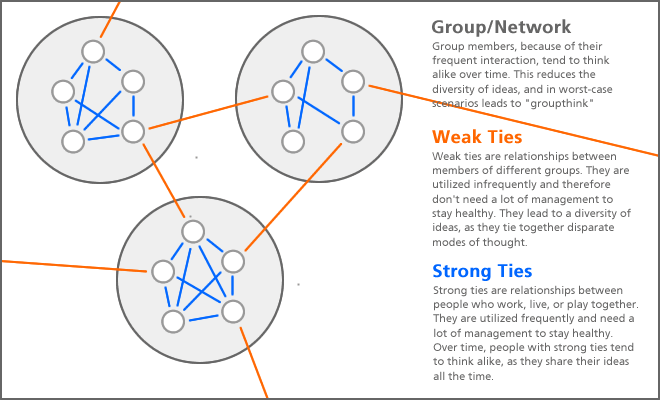
Click for full-size version
McAfee then makes an interesting point: weak ties are valuable for enterprises who suffer from groupthink. So, while there is lots of pushback on the time wasted by employees using social networking software (many companies prohibit MySpace and/or Facebook behind the firewall), McAfee suggests that under the right conditions social networking software can increase innovation:
“The implication for SNS is obvious: Facebook and its peers should be highly valuable for businesses because they’re tools for increasing the density of weak ties within a company, as well as outside it. My Facebook friends are a large group of people from diverse backgrounds who have very little in common with each other. Furthermore, their profiles give me a decent way to evaluate their expertise. These online friends, in other words, are a large group of bridges to other networks. Facebook already provides me a few good ways to activate these bridges for my own purposes. I anticipate that enterprise SNS (whatever that turns out to be) will have many more.”
The design challenge, then, is to build software that leverages weak ties. The “network” feature of Facebook is an obvious example of a way to organize groups, but does it improve communication between the members within?
Previous
