Facebook and Circles of Relationships

by Joshua Porter  |   24 Comments  |  shortlink: http://bokardo.com/p/622

David Kirkpatrick’s has written a great piece on the new direction Facebook is going. His lead in says it all:

“Imagine that when you shopped online for a digital camera, you could see whether anyone you knew already owned it and ask them what they thought. Imagine that when you searched for a concert ticket you could learn if friends were headed to the same show. Or that you knew which sites – or what news stories – people you trust found useful and which they disliked. Or maybe you could find out where all your friends and relatives are, right now (at least those who want to be found).”

Notice how each one of the examples relates the person with what they’re trying to find out by way of Trust. In other words, information is important to people not just because of what it is, but because of what it means to the person and their future. Knowing what concerts are playing is nice…but knowing which one your friends are going to is what’s important.

Schneiderman’s Circles of Relationships

Ben Shneiderman came up with a nice graphic to illustrate this. He calls it the circles of relationships. It shows several concentric ovals (centering on the self) that illustrate how Trust dissipates outward. As we move away from people near to us, we trust them less.
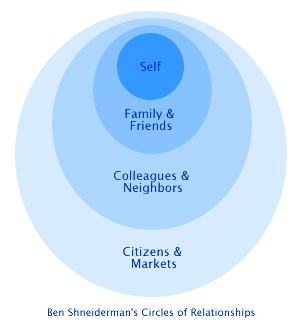
Ben Shneiderman's Circles of Relationships

Much of what Facebook has in store is about leveraging our social relationships in this way. The scope of what they’re doing is really amazing…opening up their database so that 3rd parties can create tools to leverage those relationships in countless ways. Facebook is smart to realize that it’s the users who will innovate best here…because they’re the ones who know what’s important to them.

Further reading: Chapter 5 of Sheiderman’s Leonardo’s Laptop (.pdf)

Update: Extending the Circles of Relationships

Check out my latest project: Make them Care!, a book on designing great sign-up experiences. Get reminded when it's published.

Links to this Post

Comments

1.  Michael Clarke 11:15am, Fri 25th, 2007

Enough here to keep me going for the weekend. Great post – thanks especially for pointing out the Scheiderman material.

2.  J.T Dabbagian 12:10pm, Fri 25th, 2007

So, basically, now people’s friends will be used as advertisements? Wow, we’re gonna become our own spammers….

3.  Britt Raybould 1:08pm, Fri 25th, 2007

Great post. The people we trust act as filters for all the noise that surrounds us. Friends and family know what matter to an individual. The good stuff tends to get through, the bad stuff stays blocked. If you didn’t have the different levels of trust, all the information could leave you overwhelmed and frustrated.

4.  Alex Mather 3:36pm, Fri 25th, 2007

Spot on. Facebook is indeed doing this. I think it backfires.

Here’s my take on the circles that the perfect social network protects.

5.  Andrew 3:57pm, Fri 25th, 2007

Huh, I’d have thought you’d find the Schneidermann diagram an oversimplification. If some peice of social software let you choose to mark other people on the network only as “Family or Friends”, “Colleagues & Neighbors”, or “Citizens & Markets”, I bet you’d criticize it as overdetermining relationships that are really much more fluid and complex than that.

The diagram doesn’t exactly say anything non-obvious, does it? And you could probably replace its assumed “Trust” with other social currencies and have it still make sense.

6.  Brad Grier 4:54pm, Fri 25th, 2007

Does that mean that because I’m a friend of someone who loves PlasticFoodStorageContainers(tm) that I’ll now be subjected to adverts flavoured to attract them?

Doesn’t LinkedIn have a similar problem with the Friend of a Friend network growing…and no real relationship building other than the one to climb the career ladder?

7.  Josh 7:01pm, Fri 25th, 2007

Andrew…Schneiderman’s diagram is definitely an oversimplification. But I think that what is there isn’t wrong and can be helpful…in general we do ascribe more trust to friends and family and less to people we don’t know (citizens).

Where it gets interesting is where the model breaks down…for example we have authorities like Roger Ebert, for example, who we trust (well, lots of people do). And the question is, how do we model that in software?

In general, however, I agree with you. All diagrams of this sort suffer from oversimplification. The tyranny of each project rears its head…if each project didn’t have its own rats nests of issues then all of this would be easy.

8.  Josh 7:03pm, Fri 25th, 2007

Alex…thanks for the pointer to your diagram. I especially appreciate the “people like us” part, as I’ve recently been involved in a couple projects that leverage that. And, more importantly, I’ve heard several user interviews where that aspect has explicitly been called out.

9.  Bertil 9:52am, Sun 27th, 2007

It is over-simplication, and I have to respectfully disagree: yoummight trust your colleagues less, but I trust mine better for what they are expert in—e.g. I will never ask my mum about the latest band in town. More importantly, a colleague of yours has the same colleagues; it is hardly true half the time for cousins or friends — and tend to be awckward when talking about partners. Rather then measuring trust, you should realize you generally take what is available (scarcity of matching demands) and contextual framing: you don’t know what questions you should ask when buying a camera, but if your roommate keeps telling how great having several lenses is, you’ll probably go for a reflex.

10.  Jermayn Parker 11:59pm, Sun 27th, 2007

Is this really new news though?? I thought this is old news, just rehashed for a new market – the Internet (blogs etc)

11.  Josh 10:00am, Mon 28th, 2007

Bertil, you’re right. I was being general…there are definitely cases where you trust further sources more than closer ones.

In addition, the context of the situation matters greatly. For one thing, our decisions depend heavily on the physical spot we’re in. We might make completely different decisions if we at a mall vs. being at home with the Web.

So, let me qualify this diagram further with “in general, we trust those people we know more than those we don’t”.

Thanks for furthering this. I think as we find more and more ways to describe our decision making, we’ll build better software as a result.

12.  Keith Instone 9:28am, Wed 30th, 2007

For the record, it is “Ben Shneiderman” (no “c”). This is the 2nd most misspelled name in User experience, just after Jakob Nielsen.

13.  Josh 10:13am, Wed 30th, 2007

Keith, thanks for pointing that out! I could have seen his name in a thousand places and never realized there wasn’t a “c” after the “s”. How embarrassing!