Relationship Symmetry in Social Networks: Why Facebook will go Fully Asymmetric

by Joshua Porter  |   86 Comments  |  shortlink: http://bokardo.com/p/1006

Recent events have made it clear that Facebook sees Twitter as a serious threat to its business. First, Facebook tried to buy Twitter for $500,000,000 in stock. Twitter declined. Facebook then began describing their service in increasingly-twitter like ways, such as during the Inauguration when they showed a “live stream” of chatter alongside CNN news. And on March 11 Facebook redesigned their homepage (the logged-in homepage) to a layout remarkably similar to Twitter. As Twitter’s growth continues to accelerate, it is obvious that Facebook is trying to block Twitter from catching up.

In addition, Facebook redesigned their Pages feature. The pages feature is “a customizable presence for an organization, product, or public personality to join the conversation with Facebook users”. The pages feature will now become more like a personal profile, with status updates from a Page showing up in people’s news feeds. For example, if someone from the New York Times updates the status of the NYT Page, then a corresponding notification will show up on the news feed of all the Facebookers who have identified themselves as “fans” of the NYT Page. In this way entities with Pages (organizations, products, & public personalities) can essentially broadcast messages to their fan base.

This, of course, is how Twitter works. The difference is that on Twitter this is the default behavior for everyone, not just special entities. And on Twitter the term is “following”, not “fan”.

Relationship Symmetry
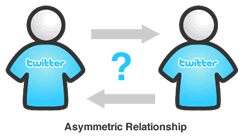
Relationship Asymmetry in the Twitter model

In general, there are two ways to model human relationships in software. An “asymmetric” model is how Twitter currently works. You can “follow” someone else without them following you back. It’s a one-way relationship that may or may not be mutual.
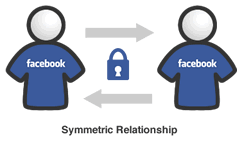
Relationship Symmetry in the Facebook model

Facebook, on the other hand, has always used a “symmetric” model, where each time you add someone as a friend they have to add you as a friend as well. This is a two-way relationship, and it is required to have any relationship at all. So as a Facebook user there is always a 1-1 relationship among your friends. Everyone who you have claimed as a friend has also claimed you as a friend.

Andrew Chen recently described one advantage of the Twitter model. It allows 4 types of relationships, while Facebook only allows for two. The two relationships of Facebook are “friend and Not Friend”. The four relationships of Twitter are:

  1. People who follow you, but you don’t follow back
  2. People who don’t follow you, but you follow them
  3. You both follow each other (Friends!)
  4. Neither of you follow each other

Attention Inequality & the Power of Asymmetry

As Andrew points out, an asymmetric model allows for more types of relationships. I think the benefits go further than that. I think that the asymmetric model better mimics how real attention works…and how it has always worked. Any person using Twitter can have a larger number of followers than followees, effectively giving them more attention than they give. This attention inequality is the foundation of the Twitter service…

Note that this is a structural concern of the software, not just a philosophical leaning. The information architecture (IA) of the Twitter service was designed in such a way to do this from the start. The IA of Facebook does not allow this. In a similar way the structure of a building determines the activity of those who enter it, the structure of social networking software determines the activity of those who use it. And from these initial, structural decisions the future of the services are, at least partially, determined.

As I noted above, for some entities on Facebook the relationship is asymmetric. But for the vast majority of “regular” people using the service (i.e. You and Me), it is not. Facebook has designed a service that forces you to keep track of your friends, whether you want to or not. :)

Facebook’s stated goal is to model the social graph. By this they mean that they want to model the relationships between all people. If you have a friend in meat space, they want to model it in software. But it has become increasingly clear that Facebook is modeling personal relationships, not relationships based on attention. That’s the crucial difference between Facebook and Twitter at the moment.

I have approximately twenty times more Twitter followers than I do Facebook friends (Me on Twitter | Facebook). I doubt I could ever have as many friends on Facebook as followers on Twitter, because if I did I would have to pay attention to all of them, all of the time. On Twitter I don’t even try to follow everyone because I don’t have enough attention to do so (I tend to follow people I’ve met). Similarly, many of the people I follow don’t follow me back. Why would they?

For the most part, if you use Twitter you accept this discrepancy. This is how attention works. Imagine if the musician John Mayer had to pay attention to all of the 422,877+ people who follow him on Twitter (he currently follows 20). He would immediately be overwhelmed. Seriously, if an full-blooded American male can’t even pay attention to Jennifer Aniston, we see how dire this entire situation has become.

We understand that attention is often one-way. While we would be angry if our friends ignored us…we are mostly fine with the fact that Tina Fey doesn’t return our dozens of phone calls.

Why Facebook will go Fully Asymmetric

I predict Facebook will soon go fully asymmetric, allowing all users of the system (not just celebrities or companies) to have “follower” relationships that don’t require reciprocation. I believe they will once again follow in Twitter’s footsteps and people will be able to have follower lists that are much bigger than the number of people they follow.

I don’t know how they’ll do this, my guess is they’ll attempt to keep both systems intact. They’ll keep the friends designation for symmetric relationships, but also add another asymmetric capability. It would probably be best to use the term “follow” for this, but they may continue to keep the term “fan”, even though being a fan of another individual sounds a bit silly…the term “follower” is better.

Facebook will announce this publicly in their common way, by saying their goal is to help you connect to your friends and family better. They’ll say they’ve realized that there are many relationships that aren’t as strong as mutual friends but are nonetheless important…and therefore they’ve hit upon this wonderful new functionality for you…and they’ll somehow recast it as “Open” in some way…and blah blah blah. Pundits will point out how they’re copying Twitter. Robert Scoble will say it’s brilliant and remind us Zuck just doesn’t care what people think. Users will revolt by creating a “Facebook Users Against Fan Designation” group and it will quickly grow to 1 million members. The actual design of the system will hardly come up. Ev Williams will probably tweet something completely unrelated. You know. The usual.

The real reasons why Facebook will go asymmetric are reach (growth) and data.

Facebook will grow their service by allowing people to accrue attention in a way they can’t currently in the system. People will realize the same benefits they currently do on Twitter…you can actually start to have an audience that is larger than your current friends list. In other words, this will allow members of Facebook to have a much larger reach than they could before…thus giving Facebook a larger reach as well. This will be the next big growth spurt for Facebook, who has executed so well on almost everything they’ve done so far…but at the present moment the structure of the system prevents this from happening.

In short, Facebook will improve the ability of its members to accrue social capital within the system. And, if you aren’t familiar with this notion, check out Yochai Benkler’s The Wealth of Networks, which lays out in excellent detail why social capital is the wealth of networks. He also describes the way humans have trouble with exchanging social capital with economic capital. (this exchange is the nut Facebook and other social networks are trying to crack)

The second reason Facebook will go asymmetric is that this will mean more data. While personal relationship data must be extremely valuable, this additional attention data is being left on the table. As Tim O’Reilly foresaw in his 2005 What is Web 2.0 post, and what huge players Google and Amazon know intimately, is that data is an increasingly important asset.

I would guess that this is why Twitter isn’t too worried about building revenue quite yet…they know how important people’s followers are to them. Hearken back to the few days last fall when follower numbers were going wonky…twitterers were up in arms! The attention Twitterers have accrued in their followers is worth serious cash. Imagine the effort of rebuilding your follower list. For example, it would take me 20 times as long to build my Twitter list as it would rebuild my Facebook friends list! That’s worth money. A lot of money.

What of Other Networks?

My good friend Christina Wodtke and I discussed this a lot at the recent IA Summit. Christina works for LinkedIn, whose relationship model is symmetric like Facebook’s. She told me that LinkedIn are *always* thinking about these issues; they obsess over the ability of their users to connect and improve relations with others. There is probably similar obsession over at MySpace, and Bebo, and well…just about any social network. My guess is that all players in this space have to be looking at the Twitter model and thinking about how they might adopt it in some way.

Where is your money?

Given their recent attempt to buy Twitter, their not-so-subtle copying of the Twitter interface, and the tweaks to the Pages feature, my money is on Facebook moving to a asymmetric relationship model in the very near future. I think their current structure has served them well, but when they look at Twitter’s growth curve, they can’t help but wonder what an asymmetric structure would do to improve their own.

Further Reading:

Check out my latest project: Make them Care!, a book on designing great sign-up experiences. Get reminded when it's published.

Links to this Post

Comments

1.  Jameson MacArthur 12:29pm, Sun 29th, 2009

Great article, thanks! I never understood it in those terms, but asymmetry does have definite advantages. It’ll be interesting to see what happens next.

2.  Mari Smith 2:29pm, Sun 29th, 2009

Fascinating post, Joshua!

I’ve been an avid user of both Facebook and Twitter for two years and currently have 5k friends with almost 2k pending – I understand Facebook will be raising their friend max later this year.

However, as I read through your post, it makes me wonder just how manageable Facebook will be with >5k… even unlimited friends, essentially fans. I think more people will keep personal Profiles just for real personal friends and family and use the Page for business. (I have ~3k fans on my Page, but to be frank, I really focus on my Profile more than my Page… for now! Mostly because of that two-way symmetric relationship you describe so well).

On Twitter, with 24k followers – and I follow all back – somehow those micro messages are easier to manage than if I had a constant stream of 24k Facebook friends sharing photos, videos, notes, links, comments, etc. etc.

The big differentiator, though, is the ability to group friends together on Facebook with Lists and view a narrower filter of my News Feed. Of course, this can also be achieved via a platform like Tweetdeck for Twitter friends. Essentially narrowing our view to only the essential relationships… but then they expand and evolve too!!

Great food for thought!!

Cheers,
@marismith

3.  David Haddad 3:21pm, Sun 29th, 2009

The asymmetric functionality that you are talking about already exists on Facebook. It requires the user to either fan a page (in case there is no real life connection between the two entities), or in case there is a real connection between them user needs to take two steps:
1. add a friend
2. hide them in the feed

In terms of the depth of relationship types: FB allows 5 types of relationships not two:
A+B are friends and both listen to each other.
A+B are friends. But only A listens to B (B hides A)
A+B are friends. But only B listens to A (A hides B)
A+B are NOT friends and no one listens to no one
A+B are NOT friends but A listens to B (A becomes a fan of B)

And the fifth type of interaction was there before the newest redesign by many months – it just wasn’t emphasized (Updates didn’t go in the newsfeed before but in the updates section)

Of course, there is a difference between how Twitter and Facebook communicate those essentially similar relationship types.

What Facebook can do is change their UI so that asymmetric relationships between friends happen in one step instead of two.

But in most cases, when a person you know, or have met adds you as a friend, you want to listen up to their stories before choosing if you want to continue or turn down the volume of them.

4.  Prokofy Neva 4:53pm, Sun 29th, 2009

David is right that FB already has the asymetrical relationships to pages, but pages of celebrities don’t have all the APIs and the interactivity that friends do.

Twitter has a fifth relational function, unless you mean that’s what the 4th kind is — the people you find in search, not just randomly on the public time line. You may not follow them or they may not follow you but you read their tweet in search.

5.  Adrian Chan 4:58pm, Sun 29th, 2009

Josh,

Great post on graph distinctions among open and closed networks. I just want to add that I don’t think social graph or social network analysis can account for differences in forms of talk online, nor provide causality in how we talk, to whom, why, and so on.

While asymmetry clearly sets up conditions that shape a) the “public sphere” in a social system, and b) means of giving/getting/sustaining attention, there are a myriad of social practices that emerge and adapt to the particular network and relational architecture in any social system — to deal with its inefficiencies as well as to exploit its idiosyncracies. To wit, on twitter, the use of @replies, hashtagging, and soon, real-time search.

The problem of attention is an interesting one, for on Facebook it can be sustained on the page, and through activity/news feeds that document page-centric activities. Facebook is borrowing from twitter’s flow-based model of talk. Pages are containers, and as such are more efficient at preserving and documenting activity (interactions, communication, and individual user actions).

And facebook pages are of course contained themselves within a community. The walled garden online community may not benefit from the openness of a twitter, but increases the probability that our communications will be seen. Containers, if you will, aggregate an audience architecturally, and supply a stronger warranty that our activities will be noticed by those we care about.

But twitter is a flow/stream-based application, and it suffers the attention deficit disorder that comes with a stream of talk off or outside the page. It is hoping to use search as a way of surfacing relationships and talk, as well as enabling discovery around those. Third party apps and clients can also help to capture and channel attention and communication, facilitate new relationships, topical content aggregation, and so on. I use several panels in tweetdeck to cool down the flow around people I’ve grouped by industry, profession, friend type, etc. So twitter’s relationship structure alone can’t explain, or account for, communication and interaction practices, nor even relational practices. Those belong to UX and social interaction design, which of course go hand in hand with IA.

Lastly, for me, is the hugely important and uncharted psychological dimension of online interaction and communication within online publics whose architectures may lead to social distortions and practices favoring, for example, popularity, “influence,” varieties of etiquette, and more. Social network analysis treats the node as a black box, and leaves out the forms of talk that form around unilateral, paired, or triangulating interactions. Twitter’s asymmetries create more ambiguities around intent and motive, and of course “uptake” and attention — some of which I think are compelling features in and of themselves.

As FB integrates twitter-like functionalities, I’m sure twitter apps and services will seek to provide more contained and persistent relationships and conversations. Some through architectures, but some by tweaking architectures to engender the social behaviors most likely to appear in response.

cheers,
adrian

6.  Bertil 6:04pm, Sun 29th, 2009

Thank you for pointing that out David Haddad — well, you scooped me to the comment, and left us without a feed to follow your insights from.

7.  freeryan 6:37pm, Sun 29th, 2009

The problem with asymmetric networks is that you never know if the people you listen to are also listening to you. If Facebook goes asymmetric, they’ll lose what a lot of their initial users enjoy about the service, which is a kind of sense of security. They like the garden walls and the cleanliness of symmetric relationships. FB needs to take care not to frustrate these users as they’re the ones that will tip the scales from interesting service to household name.

8.  Donna 6:39pm, Sun 29th, 2009

Josh — Very insightful and interesting for understanding some of the psychology of the Social Media which helps to make decisions in how to use and invest in them as tools, and also to understand the implications. Thanks! Now, will also read the O’Reilly article and Benkler’s book. And you have a new follower!

9.  Hao Lian 8:51pm, Sun 29th, 2009

I’d like to see Facebook’s approach to privacy with this feature. The interface is already pretty granular (networks, friends, friend lists) and slightly overwhelming. Twitter, on the other hand, has always taken the approach that everything you type out is public except direct messages.

With asymmetric friendship, the privacy interface will have to launch into networks, followers, mutual friends, and friend lists, and Facebook would embark on a magical journey to find the defaults that angers the least number of people.

10.  Rob 9:01pm, Sun 29th, 2009

Nope…Facebook may increase the number of friends one can have, but it will not allow for asymetrical relationships. Here’s why…

FACEBOOK’S BUSINESS MODEL AT THE MOMENT IS ADVERTISING.

If you have a fan page for your business, in order for you to broadcast your fanpage to Facebook’s 150M, you must pay for CPC or CPM. And, because currently only those who have signed up to be your page’s ‘fan’ can see any changes you make to the ‘fanpage,’ reach is limited to only those who already know about you. This is the foundation of FB’s biz model. An asymetric design is not wired into this foundation.

11.  Charlie Malouf (@iPosit) 9:54pm, Sun 29th, 2009

Joshua (or Josh) – Really insightful post. I look forward to reading more of your insights.

- Charlie (@iPosit on Twitter)

12.  rentalo 10:23pm, Sun 29th, 2009

Great article Joshua! It’s really amazing to see the traffic growth of twitter in the last year. One thing I have noticed is Twitter’s growth in the news and media. I really think they will be worth a lot more than the 500M facebook offered them!

13.  Ben Nevile 11:03pm, Sun 29th, 2009

@David Haddad, it’s not currently possible for user A to become a fan of user B. you can only fan a “page,” not a “profile”.

Joshua, I agree with your prediction that Facebook will do their best to encourage asymmetric relationships. The critical design issue they have to grapple with is privacy. Transitioning to a public-by-default environment will be a tricky dance, and I do not envy the interface designers – the system is already very complicated for Joe Average. As you say, having been designed this way from the start, Twitter has a big edge in this dimension.

Beyond that difficult interface problem, Facebook also has to expose the public stream with direct and search APIs if they want to douse the twitter flames.

14.  maneesh 2:09am, Mon 30th, 2009

wow!! nice article..never thought the “relationship models” have such important role in social networks.

15.  David 3:08am, Mon 30th, 2009

I feel that facebook as basically dug themselves a hole. They came in early and put too many features in that are ‘half-done’. Then sites like twitter come along which focus on 1 feature and can concentrate on making that 1 feature perfect for it’s use. Bigger is not always better.

16.  Rob Banks 4:29am, Mon 30th, 2009

An interesting read but unfortunately it shows a lack of insight as how to achieve specific goals in Facebook such as an assymetric relationship. It is possible to set up a Fan or Group page and use that as a one way account for followers while keeping your personal account separate, of course under a different name. What this article shows is that the ego of the Twits is greater than their real importance. If you want more followers than Twits you follow then you had better have something to offer. So far from my experience most Twits don’t have a single thing to offer and there is an extreme volume of plagiarising which is frankly very annoying.

17.  Brian Oberkirch 7:57am, Mon 30th, 2009

Though asymmetry would seem to run counter to the original premise of the system (safe place to share with those in the same contexts as you). I agree that a company built around FB Connect has a different model of sociality, but this post argues for a fundamental redrawing the of the original deal made with users.

18.  Alex Mather 9:13am, Mon 30th, 2009

I agree Josh. I’d imagine its only a matter of time before users can “follow” another user (not “page”) without the user’s permission. (Given the user’s privacy settings are configured as such.)

The key is allowing the user (and everyone else) to see how many people are following them. It facilitates the user’s egotistical urge to “prove” how popular they are. Yawn.

BTW, anyone who clogs my Facebook feed with updates about what they had for breakfast, lunch, dinner, and their 2 snacks each day gets blocked from my feed. I have 20 people blocked and the list keeps growing. If only there was a way to only block tweets in my feed…I digress.

I’m with Fred Wilson on this one.

19.  Jaime 9:48am, Mon 30th, 2009

Very insightful. You have just gained a new follower

20.  Larry Irons 10:04am, Mon 30th, 2009

While I agree with Adrian Chan’s distinctions, I’d also assert that the Dunbar Number and reciprocity are limiting constraints for both the social network applications, regardless of their information architecture. It is more an issue of hammers and nails in managing the challenge of communication.

Finding the Social Core of Facebook Friends

21.  Colin S 10:31am, Mon 30th, 2009

While Facebook is extremely popular, I find it all a bit rigid and complicated – but then I’m 50 this year – what do I know! What I do know is that the biggest gients in the game can crash and loose popularity if something better and easier comes along. While I’m not yet a user of Twitter (WHAT – am I the only one!), it does seem that twitter is easier to use and understand. Its what I guess I would expect from Web 3 or maybe web 2.5. It will be very interesting 2 to 3 years from now where all these players stand and how Google performs in this area.

22.  tony lazzari 11:00am, Mon 30th, 2009

Interesting analysis. As a user of both they are different platforms for different purposes. The best analogy of Twitter as a cocktail party and FaceBook as a nieghborhood really does seem to apply. Twitter is a useful tool for finding common interest and establishing dialogue. Facebook is a platform for expanding that relationship.

23.  Ralph Slate 11:07am, Mon 30th, 2009

I think that Facebook would be making a mistake in trying to emulate the Twitter relationship model. Maybe I’m just an old fogey, but the twitter model seems too superficial — if I can’t control who is following me, then I will more tightly control the information I’m releasing. It sounds almost corporate.

I think that this latest Facebook design change is a step in the wrong direction, because it moved a lot of items from “broadcast” to “inquire about”. I can no longer automatically see it when a friend has added a friend (my biggest source of finding new friends). I can no longer automatically see when a friend changes some profile information.

To me, Facebook was about keeping track of what friends are up to *at a distance*. I don’t have time to regularly communicate with every friend, Facebook did it for me, by broadcasting my changes to a select group, and by allowing that select group to broadcast changes to me.

If I want to use Twitter, then I’ll use Twitter.

24.  Julie 11:12am, Mon 30th, 2009

I have a twitter page, but I think it’s kind of stupid. It’s facebook without the interesting parts. And honestly, the privacy thing is turning into a huge issue nowadays. I think if facebook made it so people could follow you without your permission, everyone would make a big stink about it. Future employers could look you up, and even if you made your profile private, they could still see you? I don’t see that happening.

25.  catherine-w 11:37am, Mon 30th, 2009

On the theme of symmetrical interactions, one interesting trend that I’ve observed over the last year is the increasing use of Twitter as a replacement for IM and email. Even if you follow a relatively small number of people, you can be party to a huge number of threaded conversations, almost as if you were sitting in a chat room. Among my social group, at least, Facebook doesn’t seem to be used in the same way, even though it offers what is arguably a better interface for threading in the form of comments on posts.

26.  rentalo 11:38am, Mon 30th, 2009

Well … lets not forget that 500 million in stocks are not exactly 500 mil!

Regards,

Julian
vacation rentals

27.  Sam Jones 11:47am, Mon 30th, 2009

This post was amazing. Spot on job and a very nice analysis of what I also think MUST happen with facebook.

28.  Annuity 12:00pm, Mon 30th, 2009

Excellent analysis. It seems like as the formula for quality social networks gets refined, the myriad of web 2.0 sites out there will start to step on each others’ toes, which will lead to massive consolidation. If Facebook starts to function like Twitter, why is Twitter needed?

29.  piers 2:11pm, Mon 30th, 2009

@Annuity – If fb starts to function like twitter, why do I need fb? I originally appreciated that fb was a walled garden that didn’t bleed social network into social networking.

30.  Dave Johnson 2:16pm, Mon 30th, 2009

IMO the success of Twitter is that is has just the right degree of symmetry in its follow relationships, and maybe more importantly in its communication relationships.

By using asymmetric follow Twitter users are able to become rock stars with thousands of followers and they are (importantly) equally able to actually communicate and send messages to rock stars. So while the follow relation is highly asymmetric (although in reality a lot of people do follow back) the communication relation is actually more symmetric than some other means of communication like phone calls, emails or Facebook friend invites since Twitter messages have a very low barrier to response. You don’t need to engage is a symmetric relationship like becoming Facebook friends making symmetric communication that much easier.

31.  Neil Gunther 2:24pm, Mon 30th, 2009

Simply put, this “asymmetry” is merely a reflection of the fact that Twitter is to FB as UDP (stateless) is TCP (stateful). In other words, it takes less “energy” to create associations in Twitter, and that’s the win, IMHO. See my blog post for more perspective. (Will anyone actually read this far down in the comments!?) :-(

32.  Cem ARGUN 3:22pm, Mon 30th, 2009

Hi Joshua,

It’s really a good post to start a discussion. I mostly disagree with you, but you made me think, so thanks anyway.

First and foremost, I think that Facebook should have ideally stored the valuable “who invited who” relationships. The direction of the invites would have provided them with valuable influence and popularity information and some kind of relationship asymmetry. So ideally they would not just have “friend or not” data, but “who brought in whom” data as well. The value of social ads would then be highly leveraged by accurate influencer identification. I don’t know, maybe they store this reciprocal data, but this is sure not accessible through their API.

Twitter and Facebook are not the same species, their DNA is totally different. So Facebook becoming a Twitter or vice-versa will eventually fail. You can not breed cats “with” dogs. Yet you can breed cats “and” dogs in the same house. We should take a moment of truth and chose not to mash-up everything.

Twitter’s DNA lacks the profile advantage. So when there are “nicknames” rather than “real persons” reciprocity is doubtful. How the hell am I supposed to remember my friend’s nicknames, to follow them back anyway?

Also I think Facebook would face great difficulty in implementing asymmetry at such late stage. A friend that you do not follow or are not a fan of, will no longer be perceived as a “friend”. So following some friends and not all of them will jeopardize your social wealth, eroding the overall utility of the whole Facebook network. The only level they can do it, as David Haddad puts it, is how they already enable hiding people in the feed.

I agree that rebuilding a follower list elsewhere might be super-difficult for super-influencer bloggers like yourself. But the average social guy on Facebook with around 300 friends does not necessarily have more followers on Twitter. I bet the average ratio would be 10:1. To be a popular guy on Facebook, all you need are friendships & social relations, everyone can do that, explaining the global success of Facebook. But the attention inequality is harsh and to be a popular guy on Twitter is very difficult. Being all “follower” when no one is “following” you is no fun. This fact at some point will slow Twitter’s growth and limit it to world’s influencers.

33.  Christina Sponias 3:52pm, Mon 30th, 2009

Twitter became too popular and its functionalism really helps everyone feel better because they don’t have to follow everyone.

I think that you didn’t mention the most important point, though: at Twitter everyone sends messages to their followers all the time, what means that when you are there, you are always receiving and sending messages.

At Facebook you don’t have this constant contact with everyone. You exchange messages with your friends once in a while and for certain reason. You won’t send them a message just saying: “Read my last article”. You may only invite them for a teleseminar or something similar.

At Twitter on the contrary, you keep sending short messages with your links, to all your followers. This constant communication is the best part of all, and you can talk about anything you may desire.

http://www.scientificdreaminterpretation.com

34.  J.A. Ginsburg 4:33pm, Mon 30th, 2009

Great post. I have never been a fan of Facebook and find Twitter both useful and delightful. Facebook insinuates itself, while Twitter facilitates. Traditions such as #followfriday and follow tweets during # events (conferences). The links people put up are stunningly good. It is a fabulous research tool as well as a network. It allows people who share interests to get to know one another in a way that both mimics real life and takes advantage of the web’s reach. If you want to continue a discussion with more than 140 characters, trade email addresses. What’s not to like?

35.  Daniel Tunkelang 4:45pm, Mon 30th, 2009

I’m a big fan not only of Twitter’s asymmetry, but of the way that asymmetry can be used to model the real constraints of human attention. Sadly, the way people use Twitter doesn’t always reflect that reality, e.g., someone who follows 1,000 people clearly can’t be paying attention to all of them. That’s why I proposed an influence measure called TunkRank that, much like Google’s PageRank, treats a person’s attention as a finite resource to be divvied up among the people that person follows.

Read more at A Twitter Analog for PageRank. Better yet, try computing your own influence (or someone else’s) at http://tunkrank.com/.

36.  Christina Sponias 6:08pm, Mon 30th, 2009

I don’t know… your idea is a little bit complicated.

When you are at Twitter you don’t follow everything that everyone says, but only a few messages from a few people that you are following, depending on when you’ll open your page. This is why some people use the tool tweet-later for example: they keep sending the same messages during all day so that all their followers may read them whenever they may open their page.

Besides that, there are so many tools that allow you to do so many things… I read about one (I don’t remember its name) that allows you to always follow certain people you care about, without missing any of their messages.

And new tools are appearing all the time, giving you more possibilities. This is another point that confirms Twitter’s superiority.

http://www.scientificdreaminterpretation.com

37.  Vi Wickam 10:33pm, Mon 30th, 2009

Interesting analysis, but I have to disagree with the premise that FB needs to be more like twitter. While their status update features are functionally similar, FB’s symmetrical nature provides for a much closer relationship. If you chose to friend anyone and everyone, you can, but you don’t have to.

The security of your personal information is the crux of the symmetry of FB relationships. With twitter, you shouldn’t share anything that you don’t want the world to know. With FB, you can share it just to your friends, or just a list of close friends if you want.

I like the provocative nature of this post for sure. :)

Vi Wickam
President
Principal Web Solutions
http://www.PrincipalWebSolutions.com

38.  Nick Hans 1:20am, Tue 31st, 2009

Hi Joshua,
I understand your logic that ‘more friends/followers/groupies’ increases potential eyeballs and eventual advertising revenue.
Nonetheless, from a human interaction standpoint, asymetrical/symetrical are profoundly different. Move a century back: asymetrical is broadcast; symetrical is telecommunications. Both used very similar technology but ended up with dramatically different business models…

39.  sam 2:07am, Tue 31st, 2009

In my view, Facebook nailed it for the average person. The person who is focusing on gathering followers and not friends can and will use the Pages for this, whether it is an individual or a group pursuit. The person avidly integrating GTD into their stream or otherwise focused on tasks outside of communicating with networks will use Twitter and that’s great. Both have their purpose and application. But if Facebook manages to maintain the dear and critical integrity of the 2-way connection while providing and boosting the Pages functionality and API then I think it will be a huge win.

40.  Claire 2:29am, Tue 31st, 2009

I think facebook should not try and copy the twitter model. I think the Twitter thing sounds a little false, as it is there to make people feel good by having followers which they do not follow back. I suppose it does represents real life a little more, and as much as i don’t use Facebook often, i do not accept friend requests unless I value them in some way. People who you used to know at school that used to be horrible, and then add you on Facebook – are pretty blind! But i suppose i am being harsh, and would actually be quite a hit on twitter!

41.  fadithoughtpick 3:43am, Tue 31st, 2009

I can see the importance of live streaming and the asymitric relationship twitter provides, but like David Haddad said, the way facebook doing it with options to listen/not to is the way to go for facebook. I don’t want many followers on facebook that would listen and follow every more I can make without me really knowing them.

Facebook nature is more personal. Twitter is more about specific issues. I like the nature of the two, they can live as two different services. I can’t see why one has to eat from the other market share.

42.  Fabio De Bernardi 5:03am, Tue 31st, 2009

Very nice post. Anyway I think that the mainstream audience isn’t quite ready yet for Twitter and it’s way of doing things. Not that 8M people (or haw many Twitter has) is not a very big number, but it’s not the mainstream audience made of every kind of people out there… tech savvy or not. If you’re used to facebook/msn/texts then Twitter is a bit of a paradigm shift I reckon.
However, the concept of following someone instead of being friends is easy to catch, so it shouldn’t be a problem if applied to Facebook and its average user. At the same time though I’m afraid it would lead mainly to abuses if not well managed on the privacy side… and reality is that you can’t trust people to set their own privacy settings in an efficient way most times! Only after abuses or harassment the majority of people think carefully about what to expose to whom, so if I were Facebook I’d be quite restrictive about the information shared with followers. I mean, sharing status updates is fine but pictures, personal details and other sensible information are things that you just don’t want to share with strangers. So, I hope for Facebook that they’ll execute this in a very good way, otherwise it could go back to them quite badly (I guess they don’t want to be dubbed the social network for stalkers like Myspace used to be).

43.  PLR Ron 8:11am, Tue 31st, 2009

It’s funny how they didn’t take notice or add similar features until they were running scare of losing users. Maybe if they would have improved or added to their system in the first place, they wouldn’t be back tracking.

I think the big advantage of twitter is that it’s so simple! I have yet to figure out how to set up my facebook profile the way I want. It’s a pain in the you know what is you ask me.

ronnie
private label rights

44.  David Donovan 9:46am, Tue 31st, 2009

“to keep the term “fan”, even though being a fan of another individual sounds a bit silly…the term “follower” is better.”

I dunno, “followers” always makes me think of cult leaders and/or kings. Though I can’t think of a better term at the moment… maybe “observer”? :)

45.  Jorje Skl 10:42am, Tue 31st, 2009

So true. facebook and its glorified spam machine ,not to mention the delay time in loading.
Where as twitter is light and powerful and with the privacy you want .

46.  Samantha Anne 10:57am, Tue 31st, 2009

Great article!

I totally agree with Fabio that Face book needs to make some changes specially to be quite restrictive about the information shared with followers like the pictures, because there are some instances we don’t like to share some details to strangers.

Both Twitter and Face book are indeed useful tools nowadays.

Samantha Anne Cruise
Marketing Manger
http://www.looktheageyoufeel.com/

47.  Joe Lazarus 11:32am, Tue 31st, 2009

I agree that Facebook is headed towards an asymmetrical model, but I think they should do so cautiously. Many of my less techie friends prefer the symmetric relationship that Facebook provides today. They don’t understand why they would want to share their status updates, photos, and links with strangers and they aren’t interested in announcing their interests to the world. The asymmetrical model opens up a lot of new business opportunities for Facebook, but it also runs the risk of alienating customers who prefer more privacy. Furthermore, I bet most Twitter users are only followed by a handful of people. The John Mayer issue that you describe above is the exception, not the rule.

If I were Facebook, I would ease into the transition by allowing people to opt-in to the asymmetrical system, but make the default option symmetrical in the near-term. I would opt-in, but my Mom is probably not ready for that step just yet. If Facebook made asymmetry the default, I think my Mom would stop using the service all together. In fact, many of my friends tell me they don’t use Twitter because they’re not comfortable sharing with the world… even though Twitter offers a symmetrical option (just not as the default). Eventually, most people may become comfortable with sharing publicly, but I think it’s going to take some time for the mainstream audience to get comfortable with that idea.

48.  Scottj 5:42pm, Tue 31st, 2009

In my opinion, Facebook is a place where your friends come, whereas Twitter is a place to meet people. If this was the real world, and you were at a party, Facebook is the kitchen — where all the people you know gather to talk about inane things. People don’t stay in the kitchen unless they have something to add to the conversation. Twitter is the front porch, where you simply get people on there, who aren’t there to talk, but just to sit and listen.

This point really struck me yesterday. On Twitter, I asked a work question and got no responses. On Facebook, I asked a completely inane question and got a lot of responses from people from all different walks of life.

Now, before you think this is a post that suggests Twitter isn’t a useful tool, I did ask a work-like question on a brand Twitter feed, and got all sorts of responses. But on a personal level, the new Facebook enables conversations in an easier way. And it’s easier than Twitter.

And, more importantly, the kind of friends on Facebook differ drastically from the followers on Twitter. Fact is, I can’t follow all the people I follow on Twitter, so I could never have the kind of conversations I can have on Facebook. To go back to the metaphor, I’m at a different party than almost all of the people I follow in Twitter.

So, this does have me thinking about my own personal use of Twitter. It’s a good listening tool, but is it really a good conversation tool? i can count on one hand the good conversations I’ve had on Twitter. Whereas, in just few weeks, I’ve had fun conversations on Facebook.

Admittedly, the conversation on Facebook meme could end soon. This could simply be an indication of a new toy that I play with for a bit, but then ignore because inane conversations aren’t billable — or useful.

consolidation loan companies

49.  Alex Schleber 7:53pm, Tue 31st, 2009

Some comments correctly point out that FB is already allowing for asymmetric relationships via Pages (and FB TOS forbid overt commercial activity from Profiles BTW, even though they seem to have been enforcing that less in recent months.

And the recent Pages redesign has made them more like Profiles (in fact they are now more powerful). Only problem I see:

The term “fan” that FB has used instead of follower introduces a subtle distinction of heightened endorsement: there is a difference between outing oneself to one’s world as a fan(atic) of soandso vs. merely following what someone has to say. “Fan” sounds too committed, and people might therefore be less likely to make that click.

50.  Cassie ST 9:46pm, Tue 31st, 2009

First up, I just don’t “get” FB, maybe because I’m old, and got my learning in an era of handwritten (talking inkwells here!) communication.

Second – “Relationship Symmetry”, PULEEASE! I love some of my friends dearly (even ones with FB profiles), but I am not a “fan” (even of the vast majority of the ones that really are famous), and don’t want to be described that way. Uuurk!

And if I want to communicate with them, I pick up the phone or send an email or PM.

And third, I’m cynical.

From what I’ve seen of the FB TOS every time I’ve visited to decide whether ot not to “join”, and read the outrageous “all ur base are belong 2 us” kind of clauses, or have read strories of compromised security, my reaction is WT?! People actually *agree* to this?

Until FB gets serious about privacy, security, and copyright issues, let alone “asymmetric” relationships, they won’t get the hundreds, possibly thousands of users like me.

And, they may never get me, no matter what they do. Simple as that.

FB will have it’s place, but it won’t be and can’t be the only place, so they need to get over it.

Figure out what their USP (unique selling propostion) is, and manage it to the nth degree, then Twitter and anything else that comes along, won’t matter.

Meanwhile, for busy, uno tasking, half century old braincells like mine, blogs, Twitter, email and (gasp!) snail mail, are the go.

51.  John Stack 10:38am, Fri 3rd, 2009

I really liked this article and agree with all of it. I was thinking that there needs to be more of a class definition around types of symetry so everyone can get a handle on it:

Symetric – follow-follow
Asymetric – Non-following contribution (called lurkers by Gartner Group)
Hybrid – Follow on one side, No Follow on the other.

My opinion: For FB to compete, they have to accomodate the hybrid as proposed above. In some regard, we have to be masters of our domain (in Seinfield terms.)

Great post Josh!

52.  vanderwal 10:20am, Sun 5th, 2009

This is good and maps straight to the granular social network I have been yammering on about for years. The complexity and granularity is deeper than is laid out here.

53.  Ignace / @micronauta 12:11pm, Wed 8th, 2009

Catherine-w totally +1. That trend becomes especially evident if you use a tool that integrates IM and Twitter, like the latest beta of Adium on the Mac. So there you go, if you want symmetry there is always the 1-to-1 IM right next to the social group context.

And now my US$0.02: even though Facebook has not officially gone asymmetric yet, in a way it already has and it’s not about pages. In the very Twitter-like timeline view, you can selectively hide contacts whose lifestream you are not so interested in, and it persists.

54.  Kit Krash 11:18am, Thu 9th, 2009

A very interesting article that opens up the reason that Facebook is going Twitter, but is this really in their best interest? There is a fallacy that more types of relationships = quality interactions. I also think that people are evolving out of asymmetrical celebrity worship towards what we have called in the underground New York quarters, ‘decentertainment,’ that is entertainment through immediate social interactions. This may sound abstract at this moment but I will get further into this idea in an article sometime in the future.

But getting back to Facebook, I personally don’t fan many people, and many of my friends appear not to fan much either. I am not saying that this does not exist at all in my large social network, but it is not that important. Will people evolve to it (designing interactions have to look at what people will do in the future)? I actually think otherwise, and I have my reasons for thinking so.

What I find more interesting in Facebook is that I am sharing social time with friends, hearing their stories, seeing their adventures in photos. This goes back to the source of entertainment, a social event. I also trust their recommendations on music to listen to and go to events that they are going to or recommend. That in itself is pretty amazing.

I also want to point out that many people I know are against ‘friending’ celebrities, even ones they know. It’s like opt-in spam and does not give the level of intimacy that a more selective (celebs may friend just to sell their image and for promo) friend would give.

Twitter is growing, but it also has a lot of hype that has made many of us join, but the actual experience is not very fulfilling. The noise level is very high, the sound bites not very interesting. It’s basically a spamming interface, but those with the most status get the most followers, creating the same problems we have with all old media.

Actually people today are ‘tolerating’ Facebook rather than loving the new interface. It isn’t just because of the change, it’s because it does not do what it was doing best. Now that many have committed to it by having much of their social world in it, they will have to go along with whatever changes and directions Facebook chooses to go. But something new may come along, and Facebook has opened the market finally.

55.  Patrick 11:13am, Wed 13th, 2009

Interesting that yesterday’s @replies change on Twitter actually nudges it a slight bit more Symmetrical.