Strong, Weak, & Temporary Ties
Paul Adams, UX researcher at Google, is studying what sorts of relationships people have online. His latest piece, Designing for Social Interaction: Strong, Weak, & Temporary Ties shows how people mostly use social networks to map their life, not create a whole new online one:
Paul Adams, UX researcher at Google, is studying what sorts of relationships people have online. His latest piece, Designing for Social Interaction: Strong, Weak, & Temporary Ties shows how people mostly use social networks to map their life, not create a whole new online one:
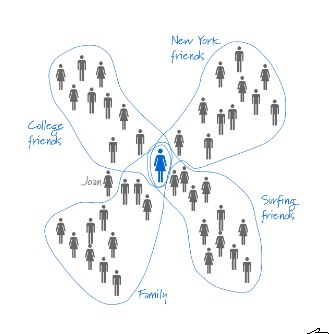
“But the reality is, social networks rarely add to our number of connections. We’ve already met almost all the people we’re connected to on social networks. We’re already connected to these people offline. Social networks simply make the connections visible. For example, we often connect with old school friends, and catch up over a couple of wall posts. But rarely do we continue the conversation once we’ve connected, and over time we forget that the connections exist. In fact, Facebook users often have no interactions with up to 50% of their connections.1 When we study how people are interacting on social networks, we see that most interactions are with a very small subset of the people we’re connected to.
The average number of friends on Facebook is 130, and many users have many more. Yet despite having hundreds of friends, most people on Facebook only interact regularly with 4 to 7 people, and for 90% of Facebook users, 20% of their friends account for 70% of all interactions. We also see this with phone usage. We have hundreds of people in our phone contacts, yet 80% of phone calls are made to the same 4 people. We know dozens of people who use Skype, yet 80% of Skype calls are made to 2 people. Even when people play computer games online, they mostly play with people they know offline.”
This is important data, as it grounds the social interaction/UX designer in the reality that most people aren’t doing anything crazy online, they’re mostly cultivating and managing the relationships they had offline.
Paul then digs deep into what he calls temporary ties, those people we meet only quickly for some relatively important reason. I really like temporary ties as an extension of strong and weak ties because it suggests clear use cases to design for. When designing for those situations in which two people want to interact but have never met, you need a reputation framework and a way for people to provide feedback to each other. This helps people make a fast decision about whether or not to interact with their temporary tie.
Also check out Paul’s IASummit talk: Bridging the Gap between our online and offline lives
