Are you Building an Everyday App? (the LinkedIn problem)

by Joshua Porter  |   20 Comments  |  shortlink: http://bokardo.com/p/1052

In a recent interview, LinkedIn CEO Reid Hoffman describes moving away from day to day to a more strategic role in the company he founded:

I want to be able to sink my mind around a couple of problems and work through them. For example, many professionals still don’t understand how LinkedIn can be valuable on a daily or weekly basis”

Another way you could phrase this is: “people don’t use LinkedIn everyday…we need to figure out how to change that”.

The fact is that LinkedIn, in its current incarnation, is not an everyday app. An everyday app is one that is used every day (or most days) by its users. This means that each and every day they do something with the app. Maybe they’re communicating with coworkers, or creating wireframes, or sharing what they ate for breakfast. Everyday apps in theory are as plentiful as bees in a blossoming apple tree. In practice, however, everyday apps are exceedingly rare.

(my friend Dave Lifson says that the folks at Amazon call returning to the site daily the “daily habit”)

So how many everyday apps are there? Well, it’s hard to tell, but probably not many. Check out the following slide from a study of teens and technology done by MTV Asia (hat tip: M. Arauz).
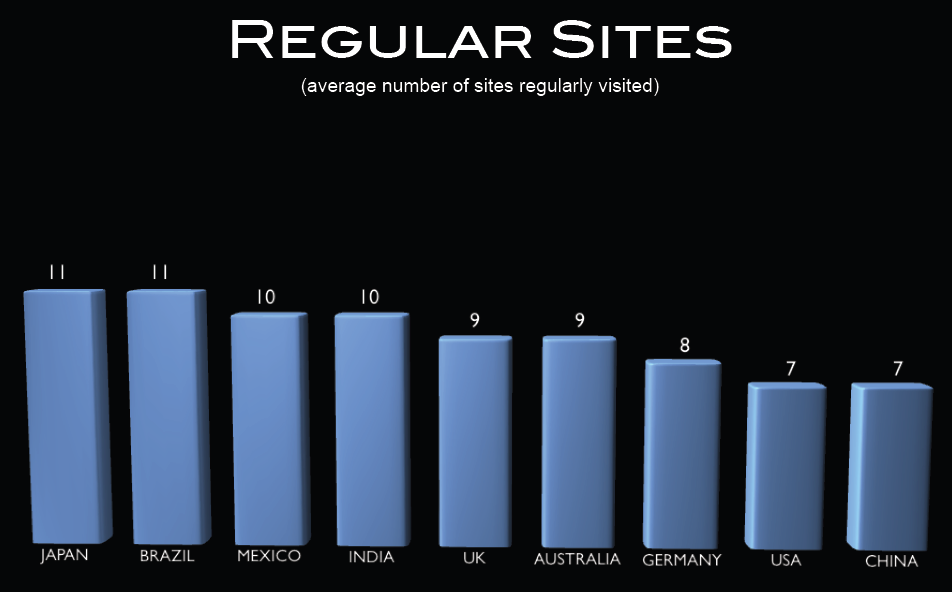
Regular Visits (# of sites visited regularly)

This study suggests that teens in the U.S. only visit 7 sites regularly, while the numbers in other countries aren’t much higher. That’s not many!

In general, most people think they’re building an everyday app, but they’re not. When the actual use patterns are discovered, most apps will be used every few days or less. Designers have to ask themselves a very hard question: “How often are people really going to use our web application?”. The answer is important…it will even help drive design decisions. Whether or not you have an everyday app affects the entire design of what you’re building, including the screens, notifications, and frequency of the service. For example, only everyday apps really need to use real-time technology to update streams. If you find out that you’re not building an everyday app, you probably don’t need to invest in making it real-time. But…you might invest in a notifications system that can alert users to when something very interesting happens.

You don’t have to be an everyday app to be successful. Netflix, for example, is not an everyday app. It’s an every-few-days app. Most people go back every few days to update their queue. There is really no need to go back more often. Another example is Freshbooks, which is not an everyday app for independents (it’s probably an everyday app for companies with a dedicated finance person). As an independent, you only use Freshbooks when you need to send an invoice or send estimates. But, Freshbooks did realize that if they added time tracking, then it became an everyday app…

Falsely believing that one has an everyday app is partially why advertising has failed to support so many entrepreneurs who envisioned financing their app that way. When people do the math and try to figure out how much engagement they’ll need to make a profit off the ads run on their site, they too often assume that they’re building an everyday app. They calculate the number of users times the number of days, when in fact they should be calculating a fraction of that. When it becomes clear that people aren’t using their app everyday, their advertising strategy falls to the ground…hard.

LinkedIn is not used every day by most of the people who use it. Many of the 38 million registered users use it infrequently. Personally, I only use it to respond to requests for connections or some other email notification I receive (sad but true). Other than pruning it as a weak-ties network, LinkedIn really isn’t that useful for me. A lot of folks I’ve talked to share this sentiment…it’s basically used as a souped-up contacts manager.

Now, there may be a subset of folks who use LinkedIn everyday, like people looking for a job or headhunters trying to find good candidates. But once people find a job they stop using it so much. They then become like the majority of professionals who have jobs (even in this economy) and don’t have time to actively look for new opportunities.

So contrast engagement on LinkedIn with the crazy engagement of Twitter and Facebook. Those sites are just waiting in the wings to start eating LinkedIn’s lunch. And they already might be. Most of the folks I talk with on Twitter are using it for professional purposes in one way or another…purposes which LinkedIn could in theory be well-positioned to help out on.

I’ve long wondered about this problem with LinkedIn. How can they increase engagement when they are often used (for better or worse) as a job hunting application? I think its an interesting problem because they certainly have enough users to play with…it’s just a matter of finding out what features can be valuable enough to get those folks coming more often.

Here are a couple thoughts:

  • LinkedIn seems to weigh social value over personal value. They focus on connecting people more than providing value regardless of connection. I will say that their Answers feature is one good exception to this, but in general the messaging I get from LinkedIn is all about who is connected to whom. The emails in particular make me cringe…I don’t care who my contacts are connected to unless I know how that other person can benefit me. My Inbox and network updates are filled with connection information…as if I want to spend time managing this stuff.
  • To be the world’s best professional app you need to make people better at their profession! This is straight out of Kathy Sierra’s School of Passionate Use. The best way to make people passionate about your business is to make them better at what they’re already passionate about. In other words, users will get passionate about LinkedIn if LinkedIn can help them do their work better. Now, LinkedIn knows what I do because I’ve told them. Why isn’t their goal to make me a better freelance consultant/interface designer? Give me some tools to do my business better, give me great content that helps me do my work better. There are places to find great content around this…it’s just a matter of curating it and publishing it.

Now, it’s possible that LinkedIn shouldn’t be an everyday app but I doubt that is the case. People are busy being professionals every day so why couldn’t an app that makes them be better professionals be a part of that? But at the present moment it still feels like LinkedIn is too focused on the connection part and not enough on the profession part.

Until LinkedIn can make us better at our profession, it won’t be an everyday app.

Check out my latest project: Make them Care!, a book on designing great sign-up experiences. Get reminded when it's published.

Links to this Post

Comments

1.  Mike Mokrzycki 8:42am, Thu 7th, 2009

Thoughtful post Josh. Couple things:

– I think there’s a way to turn off the your-connection-just-connected-with-someone-else emails (I used to get them but don’t anymore), though I’m not quickly finding the setting now.

– huge resource issue for LI with your second thought. They’d need curators for pretty much an infinite number of professions/specialties. And in many cases they’d be reinventing the wheel as there already are numerous blogs etc by specialists in their fields. A few LI groups I’m in are fairly active in trying to tackle this themselves, but that depends on the group, and blatant self-promotion/marketing/borderline spam sometimes fouls the efforts. Meanwhile, one LI group that I started and manage for a professional association is not really active on this front at all, namely because our organization’s members are conditioned to use an old listserv for discussion (and to read journals and other more traditional publications in the field).

I agree LI is most useful for job hunters, though I’m under the impression that in certain fields (tech consulting, say) it may help facilitate more focused networking among the currently employed (collaborations/business ventures/etc) than is feasible with FB or Twitter. I dunno. I’ve put a bit of effort into my profile and otherwise been reasonably active on LI and at this point I too have mixed feelings about its ultimate utility. Haven’t given up on it yet though.

2.  Alex Mather 10:07am, Thu 7th, 2009

False thinking about everyday appness not only fails the entrepreneur in terms of ad revenue but it often ruins the actual product.

features that support everyday appness take focus away from the core of the product. most entrepreneurs have delusions that their app should fit into everyone’s daily rotation and clutter their app with feeds, news, intra-product messaging, etc.

the worst part is that these entrepreneurs think that these features are crucial for launch because they are the only way users will keep coming back. WRONG. people come back for the utility of your app – nothing more.

3.  Chris Pratt 11:37am, Thu 7th, 2009

LinkenIn should bring you on ;) . I can’t say I’ve thought about LinkedIn’s situation as much as you have, but I have wondered time to time just what use it really is to me. I set up my profile, connected to all my friends and associates, and now what? LinkedIn has nothing else to offer me, so you’re right: it has become essentially relegated to a souped-up contacts manager, and frankly, I prefer using Google Contacts or Address Book for that.

However, it LinkedIn had content related to my field, I could see going back there more frequently. They could easily set up something like Google Knol or at the very least a forum, where other LinkedIn users could contribute field-specific content. Answers does this somewhat, but stops short of being truly useful.

4.  Tabrez 1:19pm, Thu 7th, 2009

Great point. I’ve felt the same way about Linked In for a while. Their groups feature is an attempt to give me a reason to visit the site. However, the groups I’ve joined seem to create spam more than anything.

The company I work for Spiceworks offers a free software for IT managers to do their jobs. We’ve succeeded in building a community around the application primarily because our users perform their jobs with our software. As a result they’re in it everyday and find it seamless to engage with the community.

5.  Mike Mokrzycki 7:54am, Fri 8th, 2009

There’s some utility in LinkedIn’s recommendations feature; I probably wouldn’t ask people to write notes for me that I would link from my resume off my own web site but trading rec’s is customary (and easy) at LI.

I’ve also used LI to reach out to an expert in a field that touches on a start-up idea I’m exploring. Now I probably could have found they guy’s email address or phone number somehow (though maybe not so easily, as he’d recently closed the company he’d run for a while) but he responded promptly to the LI InMail I sent him and soon we had a productive phone conversation.

Has anyone else out here actually paid for a LI subscription? I did, for several reasons; jury’s out on ROI at this point.

I will say a lot of people put very little effort into their profiles, and I’m not sure what the point is for them. Even if they’re not looking for jobs, more detail in the profiles should help with networking in general. An essentially empty LI profile is like locking Twitter updates or having a Facebook account and never posting anything to it.

6.  Tom Summit 9:43am, Fri 8th, 2009

LI has a lot of everyday users-headhunters. I use it everyday, all day.
Typical users are the product of LI They have a whole division writing recruiting applications that the casual users are not aware of.
As Tim Howland recently posted, LI feels like a game preserve.

7.  Tom Summit 9:58am, Fri 8th, 2009

sorry, I actually didn’t make a point in that comment.
Point is they are probably spending dev time on the area that produces the most revenue, paying customers-which are corporate and third party recruiters.
For the majority of users, LI may only be interested that you keep your employment information up to date (yearly or every few years is ok) therefore the site is not designed to be an everyday app for most people.

8.  Hair Milk 2:06pm, Sat 9th, 2009

LinkedIn is definitely not a site I use everyday and I think it’s a great move that Hoffman has decided to take a strategic approach to the company.

I’ve been making more professional connections via Twitter, and I’m sure that wasn’t one of their primary goals when starting.

9.  Bill Sempf 7:13pm, Sat 9th, 2009

Don’t confuse the needs of free and for pay sites. Netflix and Freshbooks are “every coupla day sites” but they are subscription supported so they don’t care. Twitter and facebook are free, so they do.

Linkedin is a little both. How does it fit, then? Interesting, those that pay probably DO use it every day (recruiters and salespeople). The free people don’t (I sure don’t). How does that work? Needs more analysis from that angle.

I love the post though. Keep thinking on it – you are adding value to the web!

10.  Jay Cuthrell 10:13pm, Sat 9th, 2009

Regarding Linkedin Answers — that’s already the everyday application if they do 5 things and get out of this mode of being the alternative to experts-exchange, etc… instead they should be bold and forget the models of glorified phpBB and similar ilk

Okay, the 5 things (these will likely be a mix of code and people i.e. greater OPEX loading for the service)

1) improve screening and response to Q feedback (cesspool avoidance)

2) derive a metric for activity, scoring, and mandated rating to participate (tragedy of commons avoidance)

3) highlight a Q&A of the day that is -not- from a luminary or person of interest (generate a lottery mentality)

4) delete with extreme prejudice anything remotely resembling a non-Question (stop all the “please join my group” spams)

5) rework the interface for reading and scanning through questions with user acceptance testing with the heavyweight answer folks tempered with paid newbies (stop the proliferation of assuming what they have is working well — i.e. definition of a legacy system)

HT: I got here via Louis Gray’s FriendFeed

11.  Don Li 12:20am, Sun 10th, 2009

Alex Mather,

You have some excellent points. Would like to have a private conversation on the subject if you don’t mind. donli at knowledgenotebook dot com

Thanks.

12.  Vivek 5:08am, Sun 10th, 2009

Linked in is too damn closed. Let them open up their APIs just like Facebook and let developers do their magic and come out with cool apps. Right now they are holding it too close to their chest.

13.  Sushi 7:43am, Tue 12th, 2009

If you put it this way it kinda makes sense. Apart from work I spend time only on couple sites. Sure I use rss reader for a lot more but it doesn’t count as “visiting”.

14.  John Eckman 11:25am, Wed 13th, 2009

Rewind a few years and replace “Everyday app” with “Destination site.”

In the portal (and vortal – remember that term?) heyday, people thought every site they were building would become a destination site – but the reality was that simply wasn’t possible for many of those sites.

I think it largely comes back to thinking about the value your app offers from a user’s point of view – what it offers them first, and then secondarily what it offers you as the sponsoring/creating company.

15.  dl 6:41am, Sat 16th, 2009

Josh – another great post. and I don’t say that to too many. There is a math that a lot of social media experts like to say they “get”…and they don’t. I clearly have to say you get important parts of it like Shirky, McCracken, Jenkins and Lilly.

16.  Blazing Bumblebee 4:38am, Thu 13th, 2009

I have to agree with John Pratt, having set up a linkedin profile and added the few people I know, I now don’t really know what to do with it.

Perhaps I could join a few groups or something but I already feel like I’m in enough through other social networking sites.

17.  Rick Glaser 3:03pm, Sat 15th, 2009

Great post Joshua. I really never got involved in LinkedIn and can understand why that site is not used everyday. It is also interesting to note that Google is most likely a site that is used on a daily basis in all of those countries.