Instant Tryability: the Big Advantage for Web-based Apps
Update:Added attention/tryability graph. To follow up on yesterday’s post: application innovation is happening on the Web at a much faster pace than it is on the desktop, allowing people to switch away from Windows to their OS of choice. Driven mainly by Google and Yahoo using open APIs, this innovation is showing that web-based apps […]
Update:Added attention/tryability graph.
To follow up on yesterday’s post: application innovation is happening on the Web at a much faster pace than it is on the desktop, allowing people to switch away from Windows to their OS of choice. Driven mainly by Google and Yahoo using open APIs, this innovation is showing that web-based apps are in some cases better than their desktop counterparts.
But it’s not just because these applications are better that they are being used. It’s because people don’ t have to do anything to try them. Consider a friend introducing you to two new email applications: one web-based and one desktop-based. What incentive is there to try the desktop-based application first? You only have to open the web-based app in a browser to see if you like it. If you do like it, there is no reason to try the desktop app.
There’s a notion to this: Instant Tryability. Instant tryability is a very powerful advantage for web-based apps. Not only do we never need to install anything, there is no overhead to trying things out other than to create a username and password, which has become so normal for us that we tend to use the same one everywhere. There is little pain in creating an account anymore.
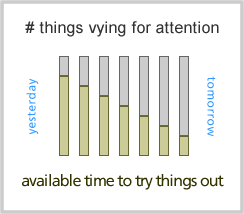
I would be interested to know how many services out there are suffering from tryability syndrome, or what happens when a ton of folks try out your service but ultimately aren’t using it regularly. I know I have about 20-30 orphan accounts drifting out there on the Web, some of which I remember and some of which I don’t.
For example, I have a Backpack account I created some time ago that I have used only two or three times since. I like the service in theory, but I haven’t started including it into my daily usage. Since I have a blog and several wikis that I use, I don’t find that I’m needing backpack right now.
But, had I needed to download anything to try out Backpack, you can be sure that I would’ve needed more encouragement before the test-drive. The instant tryability was key for me.
Have you tried any web apps lately? | Bokardo Interface
