TAG: Web 2.0

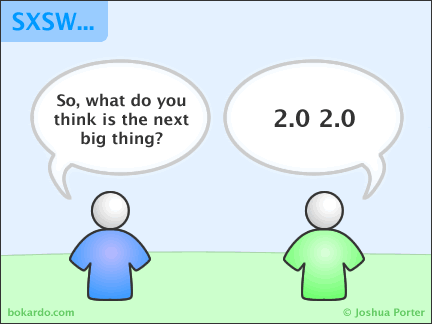
Comic: 2.0 2.0

What is the next big thing? 2.0 2.0

Continue Reading: Comic: 2.0 2.0

How to Prevent Valueless Design in Social Web Sites

How an over-focus on technology and visual design can hide the real value of social software.

In a fascinating piece on the amazing growth of the photo-sharing site Fotolog, Jason Kottke clearly articulates a growing problem in design:

Fotolog…relative to Flickr…has changed little in the past couple of years. Fotolog has groups and message boards, but they’re not done as well as Flickr’s and there’s no tags, no APIs, no JavaScript widgets, no “embed this photo on your blog/MySpace”, and no helpful Ajax design elements, all supposedly required elements for a successful site in the Web 2.0 era. Even now, Fotolog’s feature set and design remains planted firmly in Web 1.0 territory.”

How do sites with sub-optimal visual design and technology grow so big and become so successful?

Continue Reading: How to Prevent Valueless Design in Social Web Sites

The Value of Self-expression

Nicholas Carr has a great post on Sharecropping the long tail
“One of the fundamental economic characteristics of Web 2.0 is the distribution of production into the hands of the many and the concentration of the economic rewards into the hands of the few. It’s a sharecropping system, but the sharecroppers are generally happy because their [...]

Continue Reading: The Value of Self-expression

Web as Platform

Tim O’Reilly is returning to the definition he started with: Web 2.0 is the Web as Platform.
This is the definition that got me interested in Web 2.0 in the first place. It makes sense, easily contrasts with “desktop as platform”, and is accurate: we are seeing a tremendous platform move to the Web.
Unfortunately, sometime [...]

Continue Reading: Web as Platform

Grazr Goes 1.0, Relaunches with Video

Grazr.com relaunched late yesterday with a host of new features. (Marshall Kirkpatrick has the Techcrunch writeup) I helped with the site redesign, focusing on demonstrating the capabilities of Grazr as well as making the activity of building a Grazr painless and easy.

One of the new features that I’m most excited about is the ability to watch video from any web page. Here’s a Grazr displaying YouTube videos:


So it’s as simple as that. You can browse YouTube from any web site with a Grazr!

Continue Reading: Grazr Goes 1.0, Relaunches with Video

Why Netscape Will Succeed

Jason Calacanis, the man in charge of Netscape’s new Digg-like redesign, really gets social web design. Listening to this Gillmor Gang podcast, I kept thinking…while everyone else is talking about ideas, money, or conspiracy theories Jason is coolly focused on what really matters: people.

Jason is the guy who offered the top users of Digg, Reddit, and other sites money if they switch over to the new Netscape.

He also knows what all the other guys in the podcast don’t, and Netscape will succeed as a result. They may not reach Digg-like proportions any time soon, but I think they’ll be successful.

Continue Reading: Why Netscape Will Succeed

My Number is Bigger than Yours

I promise you this is not another article about Businessweek’s sensationalism, Kevin Rose’s net worth, whether or not Netscape is desperate, or the size of 37signal’s customer base.

This is a short rant about lying to customers.

Continue Reading: My Number is Bigger than Yours

7 More Reasons Why Web Apps Fail

This is a follow-up to my post 7 Reasons Why Web Apps Fail. As will the first list, this list is by no means a complete account of every reason why a web app might fail. There are countless reasons, I’m sure, and most are part of a failing strategy and don’t do the damage all by themselves. I have focused on reasons, however, based on the current situation we find ourselves in, one with extremely low barriers to creation alongside an explosion of social web applications. This combination is interesting and we’re seeing the evolution of social software in near real-time.

  1. They’re never built.
    I’ve had the same conversation with many folks: good idea for web application, but not enough motivation to build it. In fact, I fall into this category. I have several prototypes sitting on my hard drive of little applications that could be something someday, and I’ve run out of steam developing them. I get distracted, start doing something else. However, this is probably a confidence issue as much as a time issue. We’re simply not sure if what we build would be successful and investing the time it takes to push it to completion is daunting. An interesting story cropped up recently about this: Michael Arrington of Techcrunch wrote about how Squidoo.com seems to be failing, suggesting that it cast a dark shadow over Seth Godin’s reputation as a marketer, and that it wouldn’t be long before Seth distances himself from it. In other words, Mike was equating Seth’s reputation with the product he built. This is precisely why it is scary to build something in the public eye. People can ridicule it, and often do. But even if Squidoo doesn’t succeed (which is uncertain) I doubt that Seth will see it as anything other than a learning experience. Now if only the rest of us could.
  2. They’re modeling an offline activity incompletely.
    This happens a lot in banking web apps. I recently switched from my bank to one with better online features. It wasn’t that my former bank couldn’t handle the transactions, but they could only do so if I actually went to the bank and talked with a teller. This is completely frustrating. An incompatibility between an online app and an offline store doesn’t make sense. How many times have you tried to redeem a coupon or gift certificate only to find that you have to go to the store? Well, we’re so used to the online world now that the web app is the store, in both a physical and non-physical sense.

Continue Reading: 7 More Reasons Why Web Apps Fail

7 Reasons Why Web Apps Fail

Update: 7 More Reasons Why Web Apps Fail

I’m not one to believe that we’re in a Bubble 2.0 or anything like that (aren’t we always bubbular?), but here are a few ideas about why some of the web apps out there fail.

  1. Focus on social instead of personal.
    Following up on my Del.icio.us Lesson post, this is a critical reason why web apps fail. Many apps focus on being the new social killer-app when, in general, people don’t have time to worry about what other people are doing, and will only use software that benefits them personally at every step. You could call this selfishness or laziness, but I would call it optimization. For example, we simply don’t have time to tag things for tagging sake. Instead, we might tag things if we think that it will help us in the future, but adding tags to an app does not a solution make.
  2. They solve too many problems, or try to.
    This is when the buzzwords rear their ugly head. If you’ve got a list of problems you’re solving with an application, it stands to reason that you can’t solve any one of them fully. Instead of trying to solve more than one, focus like gangbusters on one problem and really nail it. If you think about the successful web apps out there right now that have garnered impressive mindshare, it should be easy to line up the one problem (or activity) they really get right. Flickr: photos. Del.icio.us: bookmarks. Facebook: college. Myspace: identity. Gmail: email. Plaxo: contacts. Tailrank: news. Etc…
  3. They’re about making someone other than the user happy.
    So much focus is on aggregation right now that it is easy to overlook the happiness of users. Many services, such as Technorati Tags or Google Sitemaps, exist solely to make the aggregators happy, and not the user themselves. They sell themselves on incentives that sound like what a movie agent might say to an aspiring actor: “We’ll make you famous, kid. You’ll get found!”. First of all, this is all talk directed at the developer, who is not the user. That’s a huge tip-off right there. Second of all, if the aggregators had their way everyone would be using these formats, which simply dilutes the value for everyone else and only serves to lock the site into some weird relationship with the aggregator. This is not how it should be. That’s why I stopped using those two services ages ago. Instead, focus on adding features that make the user happy, and when that happens everyone else can be happy, too.

Continue Reading: 7 Reasons Why Web Apps Fail

On Browse

Derek Powazek in The Wisdom of Browse:

“As the web matures, and we get better at developing member-driven media sites like Digg, we have to look beyond simplistic majority-rule popularity contests if we ever want to take on traditional editor-driven media. People are complicated, and we’re going to need complicated systems to really draw the wisdom out of the crowd.”

This follows hot on the heels of my recent post The One Crucial Idea of Web 2.0 as well as Ajit’s insight into collective intelligence, where he recast Web 2.0 principles underneath the umbrella of the Wisdom of Crowds. (collective intelligence) Alex has a nice writeup on this, too.

I’m confident that we’re seeing another insight from networked life here. The insight is that we can aggregate the wisdom of crowds, but only under certain circumstances and perhaps only for so long without evolving our systems. The recent Digg.com blowup is evidence that our systems need to adapt as their users adapt.

For those not familiar with the Wisdom of Crowds…

« Previous Entries |